(The Promise #1)
This article is the beginning of a collaboration with The Promise, the newsletter of the New Jersey Gifted and Talented Association. These articles will be published in The Promise, and available here as well.
I believe an excellent metaphor to represent engagement with the world around us is as a series of inputs and outputs. Throughout each day, we are constantly and consistently doing one of these two things. Either we are doing A – inputting things from this world into our minds or B – outputting things in our minds into the world. It is the difference between consumption and creation, a balance that everyone faces in their lifetime. Some are content to consume, while others will go mad if they cannot create. In this context, output (or creation), doesn’t just have to do with art forms, but math, science, history, and any field to which you can add something of personal meaning. A child who has wrestled with a challenging math problem and found victory in his answer has put something of him or herself back into the world, just as an artist who has just finished a painting has. Outputs look different for people of different skills and gifts, and some have a natural tendency towards creation.
Our world is rapidly pushing forward a mindset that creation is no longer necessary. Why do complicated math problems when a computer is capable of doing the same? Why write things yourself when a language model can do so? Why create art if it can be generated without putting pencil to paper? Why create music if there are so many songs already written? Why not just consume, instead of create? As a teacher, I see this reflected in our students today. There are so many who are constantly consuming. Hours and hours spent on their phones, taking in things from the world around them. TikTok, YouTube, Instagram, all of these apps and more are flooding their minds with input, and they have no initiative to create.
As a gifted community, we need to combat the seeping tendrils of apathy that choke out the spark of creation in children and adults alike. We want our children to create, to do something meaningful, to take their gifts and put them out into the world. To create something, perhaps that others will consume and will benefit by, or perhaps that brings them a sense of pride in their accomplishments.
But, as parents, teachers and guardians of these gifted minds, what can we do to nurture the spark of ingenuity that comes so naturally to these children? How do we fan the flame of creation and allow it to spread into not just an option but a desire and a drive? There are many answers to this question, and they have been answered by many smarter than I. But limiting the question’s scope to our discussion on input and output, I believe that one of the most important things we can do to help these children with unlimited potential is to give them something to consume that inspires the desire to create. So much entertainment is mindless today, games full of addictive qualities that try and get your children to empty your wallet buying ingame currency for a fleeting dopamine rush until the next best thing the game releases. TikTok feeds full of inane nonsense that is at best mind-numbing and at worst actively destructive. We live in a world where quality is outshined by what is flashy and makes money, creating an entertainment landscape full of landmines instead of goldmines. Finding gemstones amongst a sea of cheap replicas can be a daunting task, but they are out there, still being created by people who value quality and desire to make something worthwhile.
The goal of this series is to provide a varied list of quality entertainment for gifted children (though most items listed can be enjoyed by those of all ages – good entertainment tends to be timeless). Throughout this series, I will be discussing movies, shows, games, books and other forms of media, giving them an “age of accessibility,” and discussing why I am recommending them.
Video Game – Baba is You

Some of these choices will be more mainstream, some won’t. Baba is You is a game that does not lend itself to a mainstream audience for the exact reason it is such an excellent inclusion on this list. I have actually discussed this game before, going into it in a bit more detail, but it is worth including here because of how fantastic it is. Baba is You is a puzzle game, and the premise is incredibly simple. You play as “Baba,” a small white creature that you can freely move up, down, left, and right on a map. The game is divided into many levels, and at first, it seems that the goal is going to be easy – get Baba to the flag. However, this game quickly proves deceptively clever, and forces you to rethink the whole perception you have about puzzle games in order to be victorious. Instead of looking at your character, a flag that you land on to win, and walls that block your path, you instead must look at the map as a collection of symbols only given meaning by the rules text that you see on your screen.

As you can see, there is text on the map with you. One prominently says “Baba Is You.” However, every piece of text is movable. Move the word Baba, and suddenly the level locks – nothing is you. Replace You with Wall, and suddenly you can move every wall on the board, and Baba is now just a collection of pixels. You use this logic to beat levels, getting to the object that the game (or you, if the level allows you to change what is “win”) determines is needed to win.
You will not find mindless entertainment in Baba is You – instead you will find a nuanced and brilliantly developed puzzler that will challenge your child and force them to look at things in a different way. It is accessible for all ages, though it could be very frustrating for players who are too young. Gifted students of middle-elementary and higher should find this game challenging but beatable (at least up until a certain point – I hit a ceiling that I have yet to get past, getting stuck on a particularly hard level). Some will hit a ceiling, and some will break through with excitement at solving another ingenious puzzle.
There is no objectionable content that parents have to worry about in this game.
Video Game – Sid Meier’s Civilization VI

I debated for a while before putting Civilization VI on this list, but after considering, decided it definitely deserved to be here. However, in my experience, Civilization VI is a game that I always recommend with a significant caution. There are games that are easy to pick up, play for a little while, and then move on from. Civilization VI is not that type of game. For people who enjoy this style of gameplay, Civilization takes a bit of self-control to play responsibly.
The old saying “Everything in moderation.” comes to mind when talking about video games. They are an enjoyable way to spend your time, but they also can have addictive qualities that can be consuming if not careful. A game like Civilization VI is perfect for a gifted child for the same reasons this caution should apply.

Civilization VI is a 4X strategy game by Firaxis Games. If you are not familiar with the genre, a 4X strategy game is defined by a massive map and a long-term goal – to build your empire and claim victory by one of many routes (often including domination). There are many of these types of games, including real-time-strategy games such as StarCraft, the Stronghold series, and the original World of Warcraft (before the release of the massive multiplayer game), and turn-based strategy games such as Civilization, the Age series, and Stellaris. Firaxis Games released one of the earliest (though not the first) 4X game in the original Civilization, and since then have released 6 total Civilization games with another coming next year.
In Civilization VI, you start by either choosing your settings, putting together the rules for the game you want to play from a plethora of options, or letting the game set it up for you. You then choose a leader who will give you certain bonuses, and they are dropped into the game with your first town. Your goal? Expand your empire, keep your citizens happy, and develop your scientific knowledge in order to progress further. Civilization VI has a truly massive amount of systems that you learn as you play, and a game can take multiple hours to finish. There is also a ton of content in the base game of Civilization VI, with a significant number of expansions available for those who want to dive even deeper into the game.
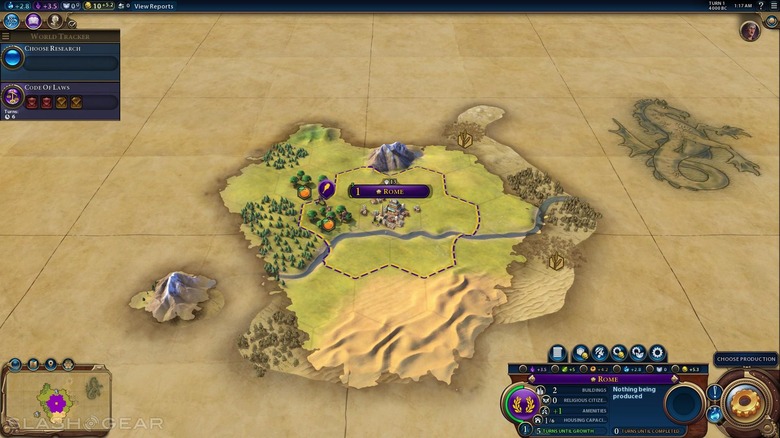
Gifted students who excel in strategic logic and critical thinking will find themselves at home in the sprawling world of Civilization VI. The game is all about planning ahead, outsmarting your opponents, and making deals with others. It is also playable in a multiplayer setting, allowing more than one person to play at once (something I have enjoyed about the Civilization series greatly – some of my best Civ memories are from playing the previous game in this series, Civilization V, with my brother). As with some of the best games for gifted students, this is not one that you can just pick up and play mindlessly. It forces you to learn its own systems, and make decisions that will keep you from being destroyed by someone who invested more in their army than you did, causing your scientific achievements to fall apart around you.
I began this segment with a word of warning for a reason – Civilization VI is easy to get swept away within. The one-more-turn mentality finds itself comfortably at home in the Civilization formula. A player can easily spend significantly more time than planned playing this game just pushing for one more turn before they stop. The gameplay loop is satisfying and doesn’t get old easily, making it a bit harder to recommend to students who have obsessive tendencies.
Civilization VI is also very accessible. It is available on all modern consoles and PC! There is no objectionable content in Civilization VI besides the fact that Wine is a luxury trade item and that you will participate in battles with other troops (no violence shown here).
Final Thoughts
Navigating the world of media can be challenging. There are a ton of games out there, and it can be difficult to parse out what games will be edifying and which ones will be destructive. I look forward to continuing to provide suggestions from my own experience to assist you in finding games that your child may enjoy!




 A Thinker in Space
Leave a reply to lorkay70a2333f0a Cancel reply