
I introduce and discuss the world of The Stormlight Archive in the previous article about The Way of Kings! I’m planning on jumping into the plot relatively quickly in this article, so if you’d like to get an overview/some background, read that article first! Once again, I will not be including too many pictures, as I do not want any spoilers for the rest of Stormlight!
The Way of Kings was such a good novel that I had to dive straight into Words of Radiance directly afterward. This happened with me while reading Mistborn as well – I was so invested in the plot that I read all six novels (at the time) back to back. Reading The Stormlight Archive has put my DC journey on hold slightly, though I am still reading through! If you want to check my progress, take a look at this page and find the arrow – that’s what I’m currently reading. But that’s not what we’re here to talk about. We’re here to talk about the 1000+ page behemoth, Words of Radiance, the second novel in the Stormlight Archive. So let’s dive in.
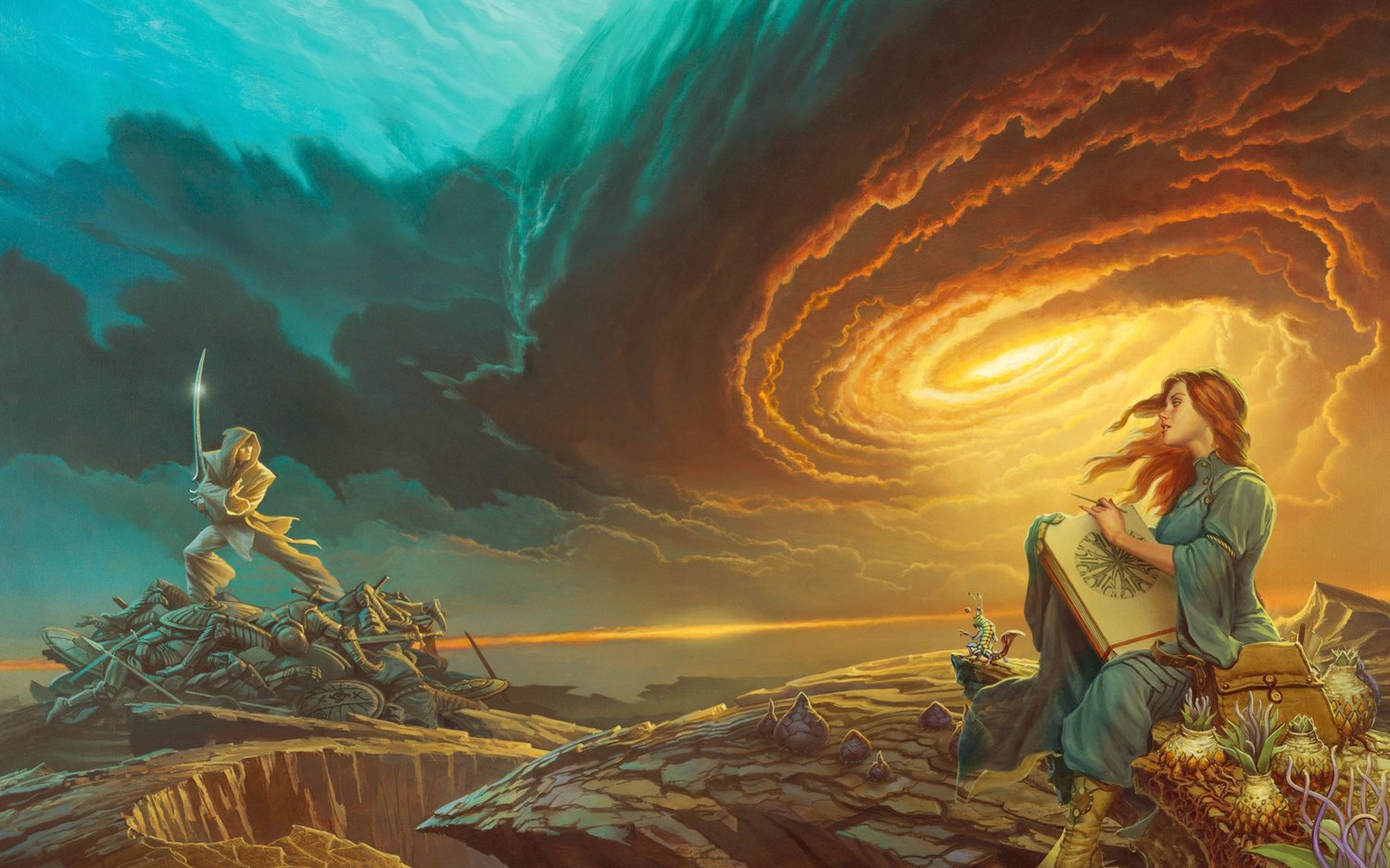
Spoiler-Free Review
This section is going to be short for this novel, because I will not be spoiling Way of Kings either, and without saying anything about the first novel there’s precious little I can say about this one. I will say this though – Words of Radiance is an incredible follow-up, succeeding in being an even better novel than its predecessor, The Way of Kings (which on its own is already an amazing book). If you are on the fence about starting this series, give it a try. It’s worth every page.
Spoiler-Filled Review
Now we can get into the meat of the story. There is so much to talk about in Words of Radiance, I don’t even know where to start. It has made beginning this article challenging. In the end, I decided to start simply by praising Sanderson’s worldbuilding. He did an excellent job of establishing the lore of Roshar in Way of Kings, and Words of Radiance expounds upon it excellently. It takes each of the four types of magic introduced in Way of Kings: Surgebinding, Soulcasting, Shardblades and Spren, and continues to expand each. We learn a ton about Surgebinding, and about the different orders of the Knights Radiant, we learn the truth behind Shardblades, we learn more about what Spren are, and each expansion dives deeper into the world.
We also learn about a fifth type of magic – the Old Gods. Sanderson gives us a look into the eyes of a parshman leader, and transforms our understanding of this species. All of these pieces work incredibly well together, and create a fantastic and intricate world.
There is so much to break down in this story that it is almost overwhelming, but I will try and go piece by piece to get through the most important parts.
The Interludes
First, I wanted to return to something I mentioned in the previous article, the seemingly irrelevant interludes in between each part. My previous comment was:
The third and perhaps most jarring part of this novel is the interludes – three chapters in between each part of the novel that are completely peripheral to the rest. Each interlude contains one chapter for Szeth, the assassin. The rest of the chapters are… strange? Each one has a different perspective, most of which feel completely disconnected from the rest of the narrative. The book ends and you still have no idea why you read some of them. Each one gives a tiny bit of worldbuilding that doesn’t feel relevant later? Occasionally, locations that show up in these interludes will be referenced in the story, but that’s about it. I am not sure yet what their purpose is, but I assume that the rest of these books follow the same model, so I look forward to discovering their purpose (and rereading them when necessary).
It wasn’t until Chapter I-3 – Rysn, that I finally understood, and understanding the point of these proved once again that Sanderson is a master weaver of narrative and worldbuilding. I spent so much time obsessing about the hidden connection to the story that I didn’t process the obvious during Way of Kings – most of these are not supposed to be relevant later. Characters may show up again, but it is unlikely unless they are already key characters. I was looking at these the wrong way. They aren’t distracting and disconnected narratives, they are well-written short stories that also take place on Roshar. My revelation came when Rysn’s chapter was a staggering 57 minutes long in the audiobook, and took place in a completely different part of Roshar with an isolated set of characters. With that in mind, not only did I appreciate the rest of these stories, I greatly enjoyed them. Each one was interesting, and introduced a fascinating new location and set of characters.
Rysn’s interlude was one of the strongest – she was an excellent character, and the cultural context Sanderson built around her was fascinating. However, there were plenty of other excellent interludes, not even including the enormously relevant chapters featuring Eshonai (the parshman woman who is goaded into bringing about the climax of the novel) and Taravangian, one of the main antagonists of the series.
Impending Doom
Words of Radiance from the very beginning makes you feel stressed. The whole novel, there is a feeling of impending doom. You learn of a future disaster in the epigraphs (short pre-chapter writings) of the first part, the coming disaster referenced in the first line of the first chapter. Because of this, you expect that the disaster will happen during the course of the novel, maybe at the end of part two. And then it keeps going. And going. No disaster. Soon, it becomes obvious that you will likely be waiting for the entirety of the novel, and that the tragedy mentioned in chapter one will not be realized until chapter 80+.
It is like being told that the boogeyman is going to come to your closet sometime in the future with no set date. You are constantly worried that today will be the boogeyman day, and are stressed every time you look at your closet.
Throughout the book, Sanderson also introduces tons of little things to be stressed about. Why do Lopen’s cousins keep joining Bridge Four? Why did that parshman just leave? What is Sadeas going to do to Adolin? Is someone trying to kill the king? Is Kaladin trying to kill the king?
Sanderson keeps the reader on edge for the entirety of the novel, until aggressively paying off all of these plot points and more in the climax with prejudice. All of these things serve to keep the reader on edge throughout the book, both anticipating and dreading what might happen on the next page.
This story has four main perspectives – Shallan, Kaladin, Dalinar/Adolin, and Shallan (flashback)
Dalinar/Adolin
Perhaps grouping these two is not fair, as they have significantly different storylines, but since they take place so close together (and give background on the situation on the Shattered Plains relevant to the rest of the novel), they’re a great place to start. After Sadeas, a good friend of Dalinar’s in a previous life, betrays the two of them at the end of the previous novel, the political game in the Shattered Plains takes center stage in this one. Dalinar and Adolin are trying to undermine Sadeas, winning his shards in duels that Adolin seeks out. By doing so, they are able to take shards from Sadeas’s allies with the goal of rallying the support of the other Highprinces. They are sort of successful, and end up with three Highprinces who are willing to ride with them into the climactic battle at the end of the novel.
There’s plenty more I could talk about here, as this book is monstrous in size. But I’m here to discuss the novel rather than summarize it, so I’ll keep moving. Dalinar and Adolin’s characters grew and blossomed throughout the book. I was sure Dalinar was going to die in this novel, but he lived again! I am looking forward to seeing what Sanderson does with these two. One of the best scenes in the book was in this perspective – first, there was a fantastic duel I will also talk about later, and second, there was Adolin’s murder of Sadeas. It was an unexpected, jarring, but fantastic character moment for Adolin, and it sets up a plotline for the next novel that is sure to be engaging. There weren’t really any misses as far as character arcs go for me reading this novel – I felt that every person’s plotline was executed well. Dalinar bonding with the Stormfather was an epic moment, and I can’t wait to see what Sanderson will do with this in Oathbringer (though I will talk about the ending of the novel in its own section a bit later on).
Kaladin
Oh, Kaladin. This arc was frustrating – the two times I was actively angry at this novel, and both had something to do with Kaladin’s story. Kaladin spends this book taking his new job to guard the king and the king’s family very seriously – it was a satisfying continuation of his story from the previous arc. He also practices with stormlight, becoming pretty good at windrunning. Amaram, the man that sold Kaladin into slavery, appears later on, filling Kaladin with a cold rage that permeates his actions for a significant portion of the novel, much to the dismay of his spren, Syl. There are some great scenes in this arc (before the end, which was fantastic) – highlights for me were the first Kaladin vs. Szeth fight – the Assassin in White and Kaladin get to go toe to toe here, and we learn some crucial information about Kaladin’s powers (specifically that he can heal from a shardblade wound). He also has an epic battle alongside Adolin, who dislikes him greatly until this scene. Adolin gets himself trapped in a 4v1, and his opponents all are full shardbearers. Renarin and Kaladin join in to fight, and Kaladin and Adolin manage to take out all four shardbearers. It was a fantastic fight scene, one of the best scenes in the book up until this point, which is why what happened afterwards was so frustrating (intentionally, I know).
The goal of the fight is to get Sadeas in the dueling ring. The king, Dalinar, and Adolin are all in on this, and the king offers Adolin a boon, which he uses to challenge Sadeas. Unfortunately, Kaladin also calls out Amaram here (which made for a shocking and thrilling moment… until Kaladin is arrested immediately afterwards). As the story continues, Kaladin learns that one of his men in Bridge Four is trying to kill the king. And as he continues to let this cold rage consume him, he promises to help his friend with the assassination, betraying the man he is supposed to protect. He has now made two oaths that contradict one another which destroys Syl’s mind, and his bond with her falters until it vanishes completely, and he loses his ability to surgebind.
Shallan (backstory)
Throughout this book, we see what happened behind the scenes in House Davar, including how Shallan’s father and mother died. These sections were interesting – I enjoyed them a bit more than the Kaladin flashbacks in the previous novel (though those were also quite good). The tragic and brutal backstory for Shallan helps us understand her a bit better, and the revelation that she killed both of her parents, and the stories behind them deaths were chilling and fascinating.
Shallan
This was my favorite part of the book, easily. The other stories were engaging and captivating, but Shallan’s was the one I was constantly excited to read (moreso in the second half of the novel). Shallan starts the novel with Jasnah, on the ship with her old friends, headed to the Shattered Plains to marry Adolin and continue Jasnah’s research. However, very soon into the book, the ship is attacked by the Ghostbloods, and Jasnah is killed (or so it seems). Shallan soulcasts the ship into water, and ends up on the shore, far, far away from safety and her destination. She ends up conning her way onto a caravan, and takes them towards the Shattered Plains. She starts off by imitating Jasnah, but ends up taking on her own method of deception. She meets a conwoman named Tyn who she befriends – Tyn takes her under her wing, and trains her in the art of the con, until Shallan learns that Tyn was the one that killed Jasnah. Tyn turns on her and Shallan kills her, revealing to the audience for the first time in a shocking moment that she has a Shardblade.
Shallan is able to turn everyone to her side and take over the caravan and a troop of soldiers, and ends up entering the Shattered Plains by storm. This is the section I thoroughly enjoyed. I am a sucker for the political dance, and Shallan learns it and plays it well. She balances her marriage-to-be, her role as a clerk and a lighteyes in high society, and her trial for the Ghostbloods (a criminal organization she has infiltrated) exceptionally well. She and Adolin make for a great match, and watching their relationship develop over the course of the novel was enjoyable and satisfying.
Her role as Veil, working with the Ghostbloods, was a highlight for me in this novel. Seeing what she can do with stormlight to disguise herself, and using it well to do what she needs to do was an excellent part of the novel. I think my favorite part of the book (besides the ending), however, was Shallan and Kaladin stuck in the chasms. Their conversation and bonding here was excellent, and the spark of a love triangle that is set up here was fun to see while being relatively inoffensive. In addition to some great character moments, this sequence served clever additional purpose. In Avengers, Captain America is frustrated with Iron Man, and says “Big man in a suit of armour. Take that away, what are you?” This is what Sanderson is addressing in this sequence. The reader (and Kaladin himself) begins to feel like all of the accomplishments Kaladin has had were because of his ability to use stormlight, even before he knew it was possible. Here, he has Kaladin take down a chasmfiend with no powers, showing us that Kaladin is Kaladin even when he is not able to “cheat” and take in strength from stormlight. The dynamic between Shallan and Kaladin is established, one that will definitely follow into the next novel.
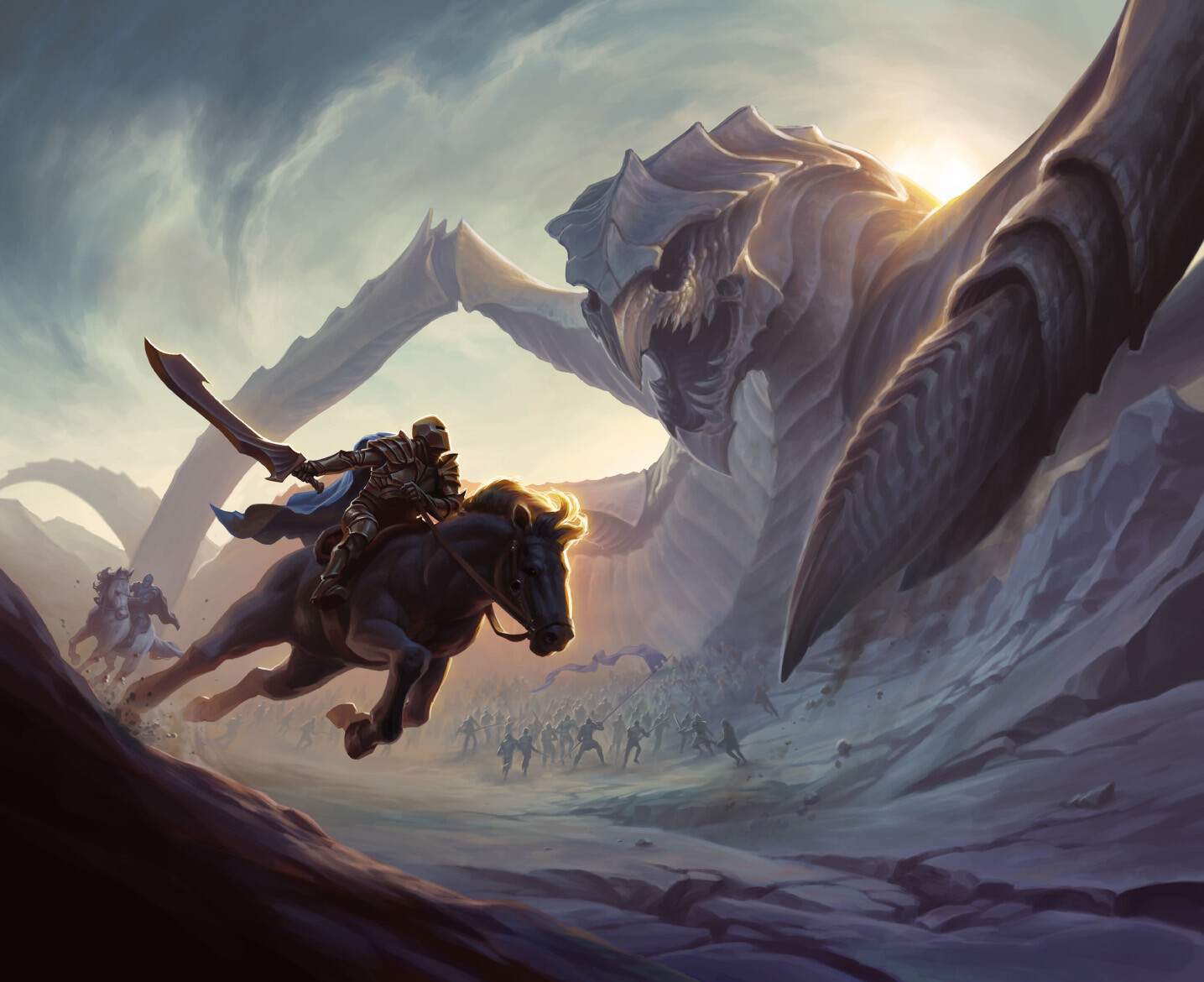
The Ending
The best part of the novel without any contest is the ending. Sanderson has a unique gift – he is a master of the third act. So many stories have an excellent buildup but fall flat at the end. Sanderson nearly always saves his best for last, and gives us a conclusion that is epic, satisfying, and often surprising. This novel didn’t have much in the way of plot twists (at least not the kinds that change the rules of the novel, which he is known for doing – you think everything is one way the whole book and then at the last second Sanderson changes all the rules). But it did have incredibly satisfying endings to all of the major arcs established in the novel.
Dalinar takes his fight to the Parshendi, with the goal of annihilating them once and for all. Unfortunately, the Parshendi have newfound power and are summoning a “storm that blows the wrong way”. The Stormfather, who we expect is at least pseudo-omnipotent up until this point, proves himself to be both fatalistic and fallible. He summons a highstorm to try and put the people out of their misery, and their survival is a surprise to him. Dalinar then bonds with him, becoming one of the Knights Radiant. This was very interesting – Sanderson’s world is full of these powerful beings that are called “gods” or shards of gods or something like that. The relationship between the spren and these creatures (like Odium, Ruin from Mistborn, and I assume Wit) is not yet clear, so Stormfather’s role is still quite hazy. We know he is a very powerful spren, but not how he functions with the rest of Sanderson’s Cosmere.
Shallan is successful in locating the mystical city of Urithiru, which will play I am sure a huge role in the next novel, and Kaladin has his own revelation – Elhokar (the king) is to Dalinar what Tien was to him – he was about to do the same thing to Dalinar that Amaram did to Tien. This is his big moment – he decides to save the king, and when he faces Moash he says the words that bond him fully with Syl, and he becomes a full-on Knight Radiant. He saves the king, and Moash ends up tied up with The Diagram (more on that later) and is whisked away by his co-conspirators. Kaladin’s choice to betray the king was a point of frustration for me throughout the novel, but this payoff was worth it. Seeing Tien in Elhokar was an “ah-ha!” moment worthy of the struggle Kaladin went through, and gave us insight on Dalinar and Kaladin simultaneously.
Then we have another of the best scenes in the book – the battle between Kaladin and Szeth as a highstorm picks up. This fight is incredibly well-written, not to mention beyond satisfying. We then see Szeth revived and welcomed into the Knights Radiant as well, and we learn that Renarin has also been bonded with a spren.

Szeth’s revival was so exciting for me – I am a sucker for a redemption arc, and Szeth’s whole situation was so well executed that giving him this chance at redemption is one of my favorite choices Sanderson made in this series so far.
All of this happens and more in the last few chapters – the ending was jam-packed with climactic moments. Sanderson outdoes himself in this novel – it is my favorite ending of any of his books so far, and some of the Mistborn endings are doozies.
The Enemies?
One more thing I wanted to discuss that I loved about this book is the antagonist(s). In the end, it seems that there are five different groups that are conspiring against our heroes. Out of these five, only one is truly evil. The rest are complicated and intriguing, making for a nuanced story with a ton of interesting angles. Sadeas is a solid villain – his motives are more straightforward and he was ruthless and calculating. However, he truly believed that what he was doing was best for Alethkar. The Ghostbloods are ruthless and seem evil throughout the book, and then at the end, it is hinted that there might be more to them than meets the eye. Amaram is working for a faction that is yet unknown (though he could be working with our next antagonist), and the story leaves you not quite knowing what to make of him.
Finally, we have King Taravangian, whose name I need to look up every time I mention him. Taravangian is a fascinating character – I really enjoyed his Interlude. He is the person responsible for sending out Szeth, resulting in the assassinations of world leaders across Roshar and destabilizing the entire civilization. He truly believes that he is doing the right thing, despite how many deaths he has caused, and he knows way more about the situation than we realize in Way of Kings. I am very excited to see how this character arc continues, and to see how he deals with the storm and the return of the Knights Radiant.
Finally we have Odium, who we know only by reputation right now despite the fact that he is the only true confirmed evil and seems to be the main antagonist of the story. The parshmen fear the return of their old gods, and Odium seems to be one of them – he sends a storm of red lightning across Roshar at the end of the novel, summoned by the Parshendi who are now taking their role of Voidbringers. It will transform all parshmen into voidbringers – turning slaves into monsters. This is likely to destroy all semblance of order left in Roshar, except in Urithiru, where the highprinces of Alekthar have arrived without their parshmen.
Wit
I couldn’t go through all of these events and not mention the epilogue and the character it follows – Wit. Some of Sanderson’s best dialogue is used on Wit – he has been one of my favorite characters since the first novel. In this book, you get a sense that he knows way more than he should, and that he is either a god himself, or at least someone with incredible power who knows about the gods. I’m still not sure what to make of him, but his chapter includes the return of Jasnah! I was very pleased to see this – Jasnah’s death was the shadiest thing in the entire novel. Shallan saw her stabbed (through the heart I guess), and that was it. It has been established that A. stormlight can heal most wounds and B. Jasnah can teleport herself into the dimension of the spren in order to soulcast. The reader is left assuming that she used one of these two abilities, but her absence gives you a bit of pause – it takes a long time for her to return. However, her reappearance gives you a sigh of relief and a smile – we now have 7 potential Knights Radiant at the end of the novel: Dalinar, Kaladin, Shallan, Renarin, Jasnah, Szeth, and a girl who appeared for an interlude in the middle of the book – Lift.
Final Thoughts
Words of Radiance is one of the best books I have ever read. I have not done a list of books like the list of favorite movies that I tackled earlier in the summer, but now, this one would be on it, and it would be high. It is in this novel where Sanderson truly shined the most for me, out of all of the content I’ve read. After reading Mistborn, my statement about Sanderson was that he was a master of worldbuilding and plotlines, but not as much at creating engaging characters. In this story, he has turned that on its head, proving himself to be a master of crafting fiction in every area. I am looking forward to return to this series after reading Edgedancer, the novella that takes place between Words of Radiance and Oathbringer – this story left me hungry to continue reading and enjoying the enticing world of the Cosmere that Sanderson has put forth for his readers to immerse themselves within.
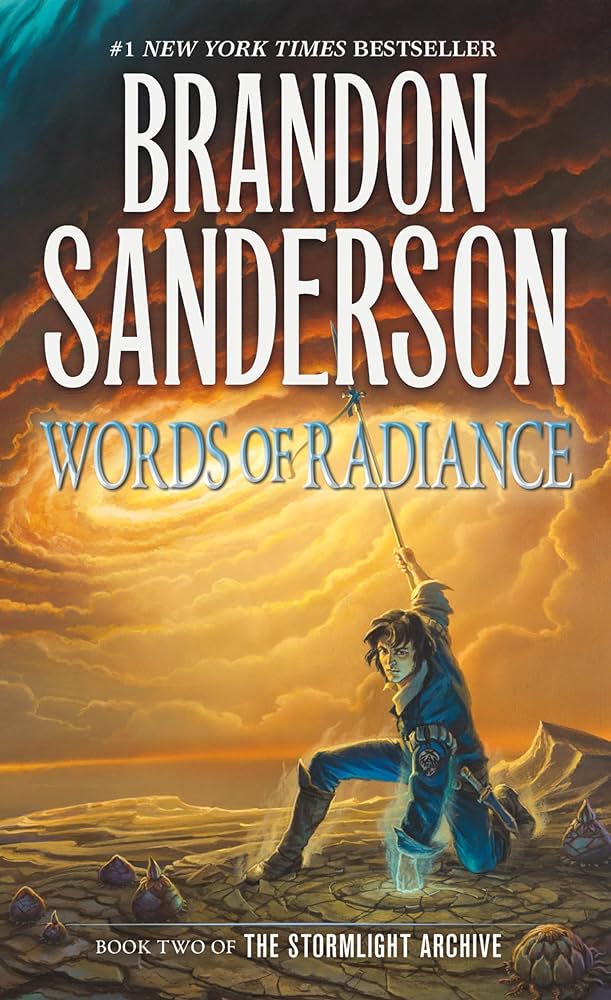
Related Reading

The Stormlight Archive #1 – The Way of Kings
A review of Brandon Sanderson’s novel The Way of Kings.

Books for Readers Young and Old – An Introduction
I will be starting a new series on this blog about books for young readers! This is an introduction to the type of content I will be reviewing.

Jon Klassen’s Hat Trilogy
A look into Jon Klassen’s Hat Trilogy – are these three books worthy additions to your collection? (Books for Readers Young and Old)

 A Thinker in Space
What do you think?