
For more information about this series, please see the introductory article here.
The Deep Cuts shortlist I have created contains a ton of games, many that I enjoyed as a child. I have some on here that are from when I was very young, and some from when I was older. On this list, there are a few games that are particularly special – ones that were staples of my childhood. Insaniquarium was one. This is another. I don’t know how many hours of Zoombinis I have played in my time, but it is a non-marginal number. My love of Zoombinis originated, believe it or not, in an Elementary School classroom. When I was younger, we had a Computers class, where we learned how to type and played educational games. Zoombinis was one of the games we had access to (I will review some of the others later on in this series, actually. I should also clarify that I am 95% sure that this anecdote is true, but there is a solid 5% chance that we just had this game at home).
Edutainment games as actual video games are hit or miss. Some are very in your face with what they are supposed to be, like typing games and games with blatant math problems to solve. These have their own place, but they are there for you to learn while you are having fun. In my opinion, the educational video games that hold up the most are ones that are a bit more subtle about what they are trying to teach you. Zoombinis is a good example of this, and this choice by the developers helped this game immensely.
The Game
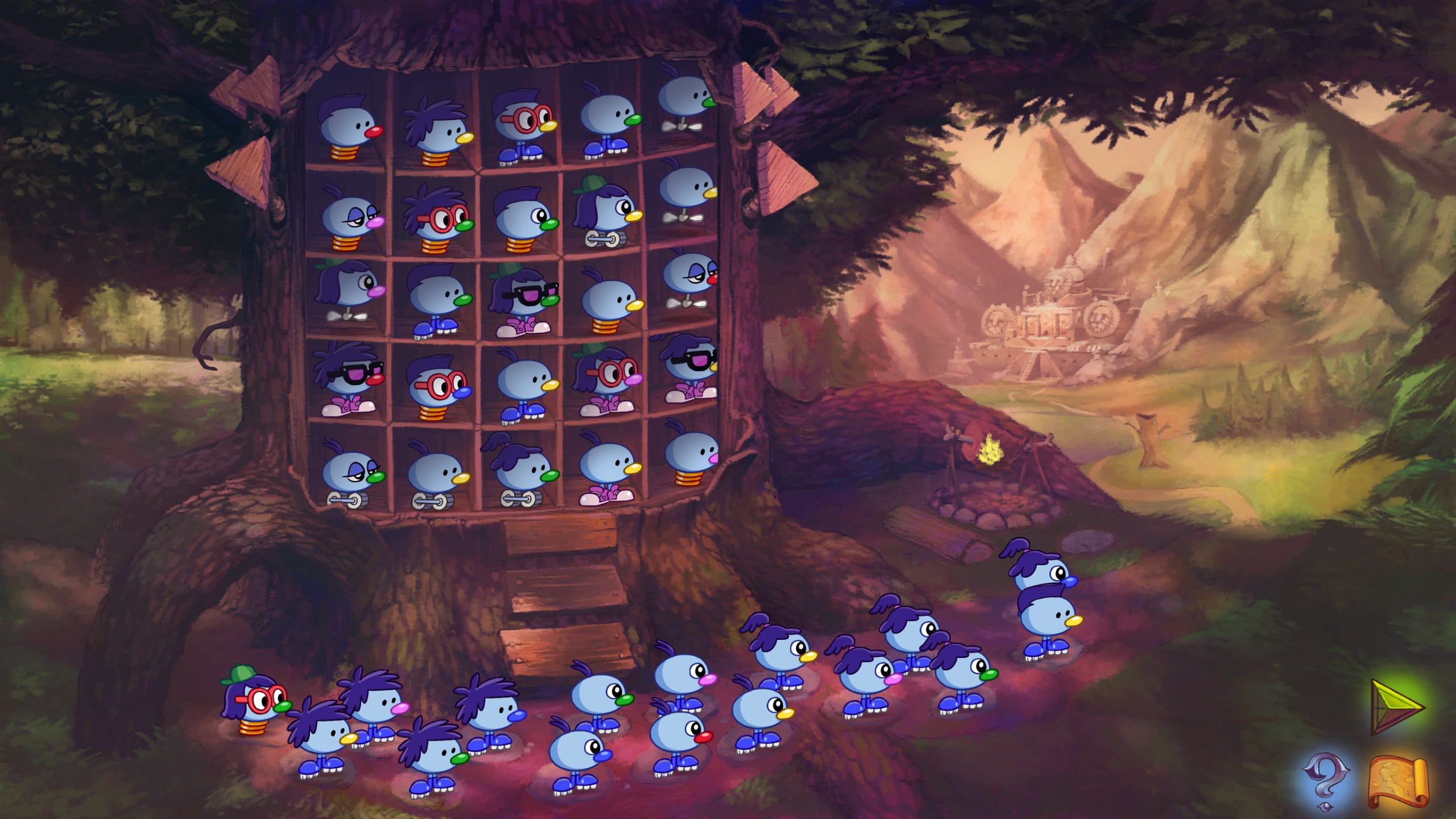
What is a Zoombini? The answer: these are Zoombinis.
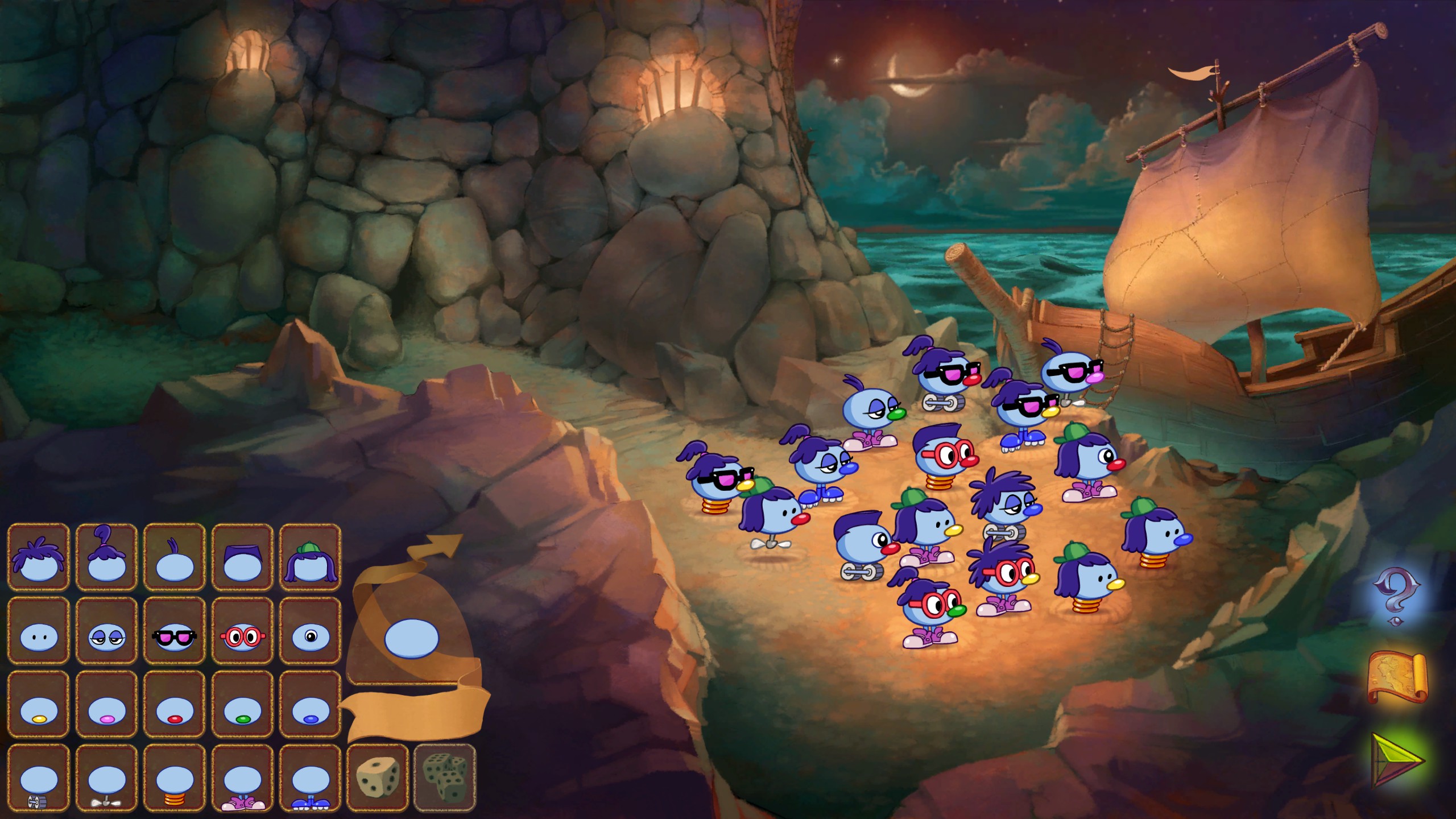
Taking a closer look at these Zoombinis, you can see that each one has a blue spherical body, and 4 flexible traits. There are 5 types of hair, noses, eyes, and feet that each Zoombini can have. This is a mix of a variety, and you can see the Zoombini creation screen on the left. When starting the game, this is where you end up first – creating a group of 16 Zoombinis to take with you on your first adventure.
The game opens with a narrative about the Zoombinis having their homeland taken over by evil creatures called The Bloats and becoming enslaved. They escape and head to another continent by ship – in order to find refuge, however, they must make their way to the other side of the map. In order to get there, your Zoombinis have to conquer challenges through a Logical Journey. Your crew of Zoombinis makes their way through 9 challenges in order to reach their new homeland. There are 12 minigames total in Zoombinis (the path branches in the middle so that you can choose between two sets of 3 minigames). Each of these minigames requires some critical and logical thinking in order to succeed.
I won’t go through all 12 minigames, but I will give some of the highlights.
Puzzle #1 – The Allergic Cliffs
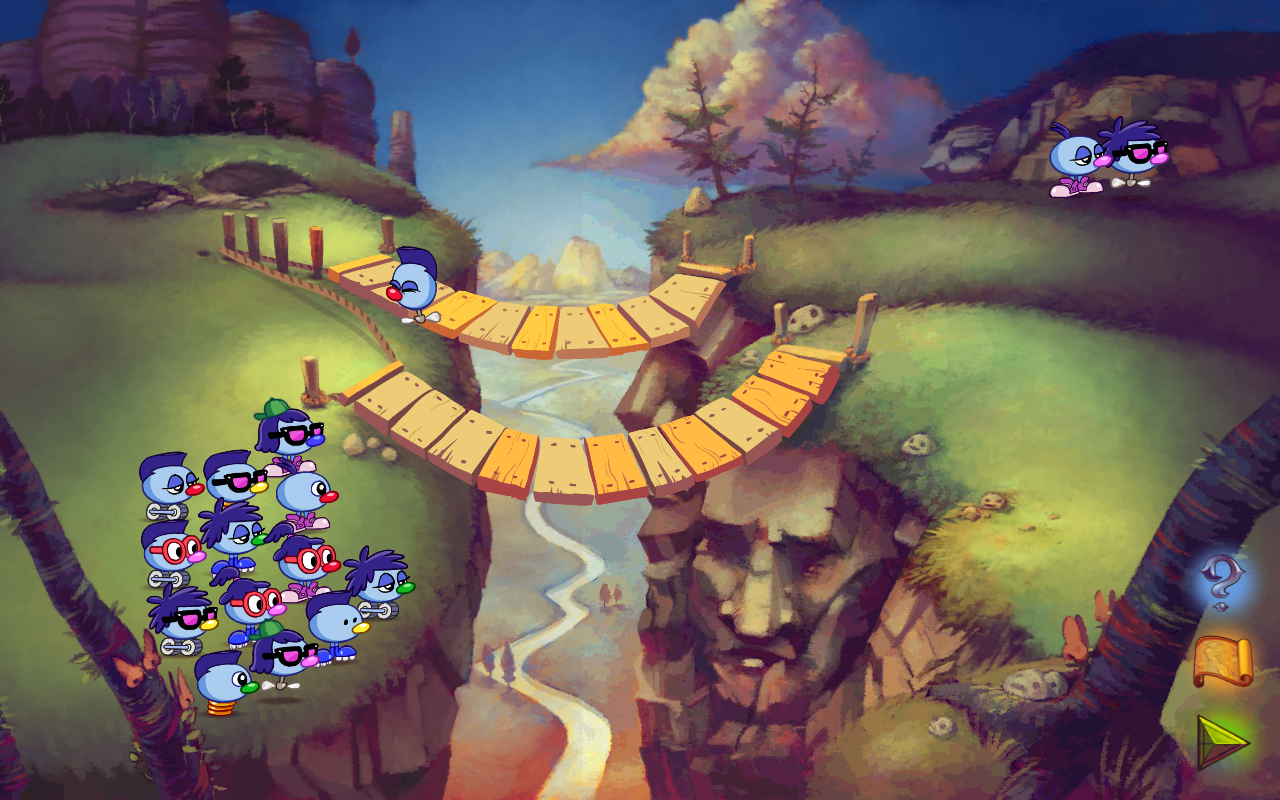
You start with The Allergic Cliffs. Two bridges are in front of your Zoombinis, and behind them are two cliffs that sneeze. The cliffs are both allergic to an attribute – if one cliff doesn’t work, send the Zoombini to the other side! You have 6 tries to get all 16 over, and as you send them, patterns will begin to emerge that can help you solve the puzzle.
Puzzle #3 – The Pizza Pass
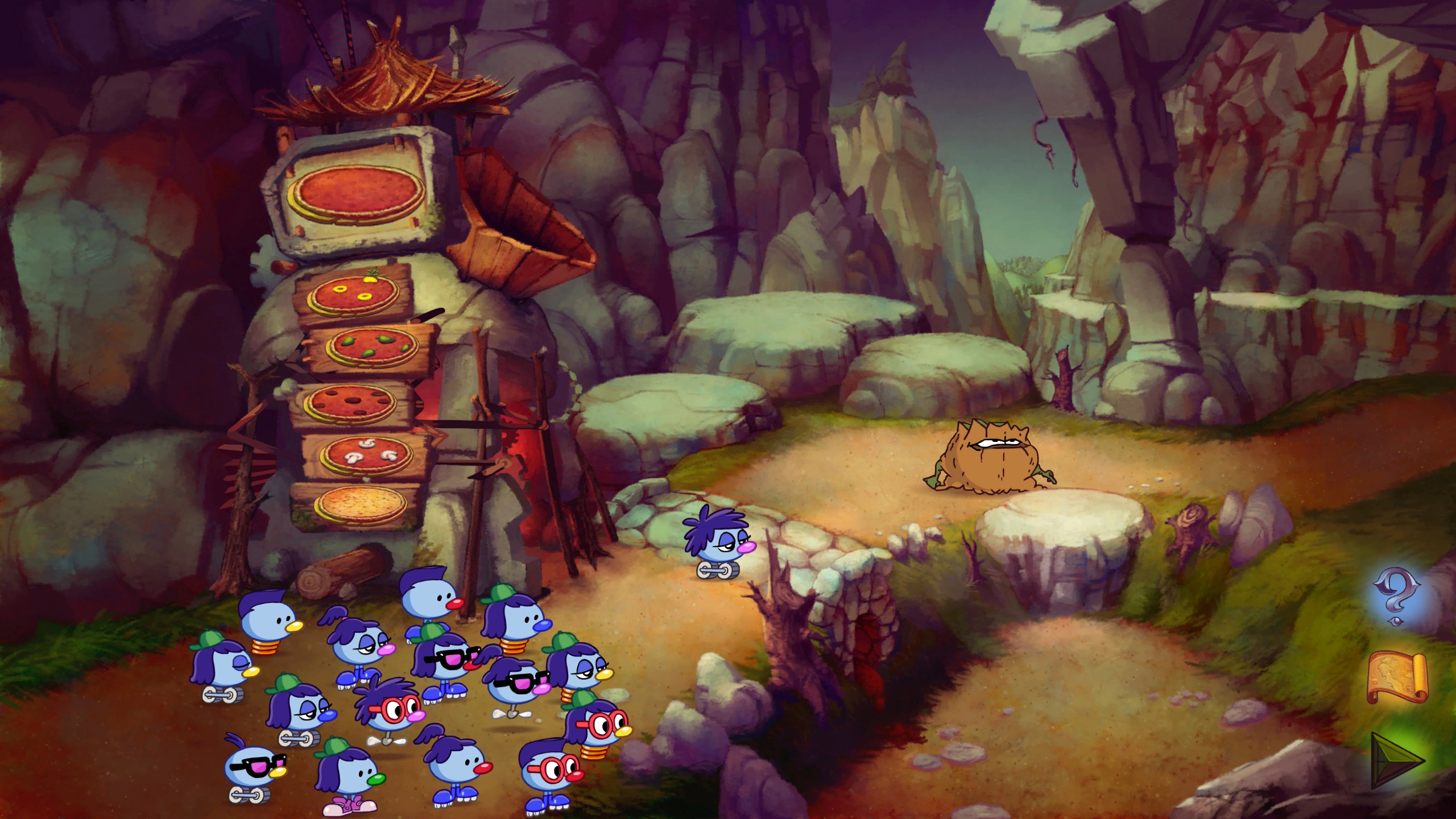
I think the game that is the most burned into my mind is The Pizza Pass. Most of the games have to do with Zoombini attributes, but this is one that is completely separate from your squad’s characteristics. Instead, you have a Pizza Troll who is hungry for (would you believe it) pizza. You are given 4 different toppings you can mix and match, and he will let you know if there’s something on it he doesn’t like, or if more toppings are needed. The actual pizza changes each time, and solving the puzzle requires guess-and-check logic.
Puzzle 4.2 – Fleens!
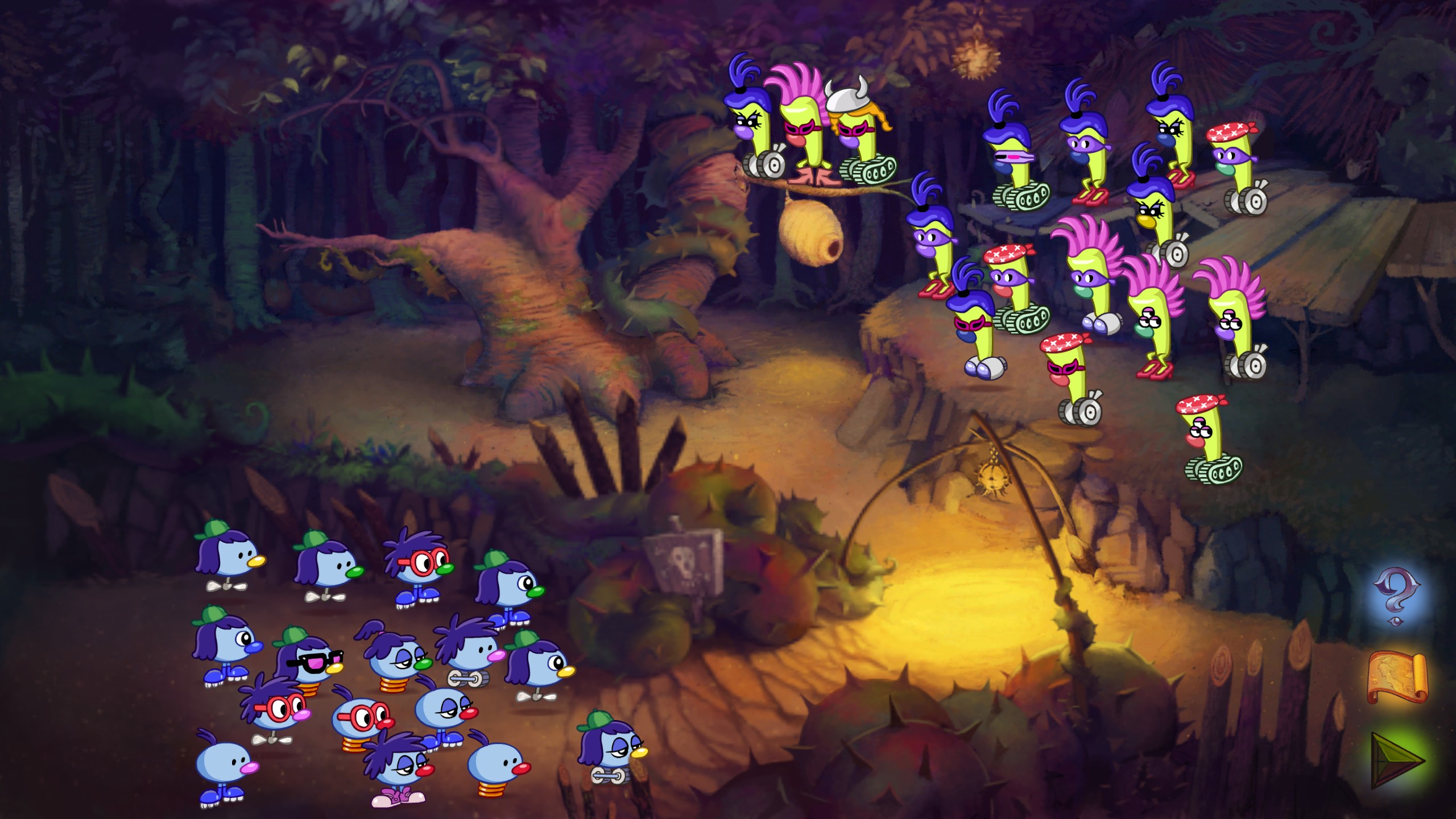
Next we have Puzzle #4.2 (I labeled it as such because it is the first puzzle on the southern side of the split), Fleens! Fleens! gives you a goal – there are three Fleens on a branch (an odd creature who lives in this land), and you have to figure out which Zoombini chases each one off. Each Fleen has the same four characteristics as the Zoombinis, and they match up 1-to-1 with your Zoombini squad. This one requires trial-and-error in order to succeed.
Puzzle #6.2 – The Mudball Wall

I love #6.2, The Mudball Wall. I liked it as a kid, and it was a highlight of each run in my recent playthrough. You are given a 5×5 grid. The rows are color coordinated, and the columns are shape coordinated. By trying different color/shape combinations, you need to hit multiple points on the wall that will pop your Zoombinis up the wall so that they can continue forward! My only qualm with this one is one that holds up for only a few of these games – the animations are slow and unskippable.
Puzzle #8 – The Mirror Machine

#8 is the iconic Mirror Machine which has you finding mirrored images of your Zoombinis to get them to pass. This one is pretty self-explanatory, but in later difficulties (which I will talk about shortly) it becomes a significant challenge.
Puzzle #9 – The Bubblewonder Abyss

#9 is the Bubblewonder Abyss. I remember this one vividly from my childhood – you are crossing a bottomless pit, and you send Zoombinis into bubbles. They follow a predetermined path, and either make it safely to the other side, or fall into the abyss (which was pretty traumatic, as this is the last puzzle in your journey with these 16 Zoombinis and seeing one you have become attached to fall to its apparent death as a child is pretty brutal). There are two options, and as Zoombinis pass over icons that point them in one direction or the other, they sometimes hit switches that change your options with the next Zoombinis. If you don’t plan ahead, it is possible to become stuck, losing multiple of your little blue friends. Luckily, any that fall or are lost respawn at a campsite. There are two of these, one after Puzzle #3, and one after Puzzle #6. These are also your only save points – if you move forward with a squad of Zoombinis, you must complete all 3 puzzles or “your Zoombinis will lose their way”, a horrifying statement to a child who is emotionally invested in their blueberry-shaped squad.
Does it hold up?
This is the big question. A game like Zoombinis has a lot to evaluate in order to answer this. First of all, there are 4 difficulty levels for each puzzle. The easiest difficulty is challenging for younger players, but older players will cruise through the campaign with nary a wrinkle, speed hampered only by occasionally unnecessarily slow animations. The final difficulties are challenging for me as an adult, adding a ton of satisfying complexity, and the puzzles scale well in between. Because of this, the core game not only holds up for kids, it holds up for adults too – I went through the game on the hardest difficulty and decided to finish my playthrough another time, as it took a bit more mental energy than I was willing to expend.

My one complaint with Zoombinis is significant. Perhaps this is because I am an adult, but I do believe this gripe is legitimate. When you are used to these types of logic puzzles, your playthrough is fun but not very satisfying. The later difficulties, however, make the game much more engaging and enjoyable for that type of player, child or adult. The meta-campaign going on in the narrative of Zoombinis is that you have 400 (reduced from 625 in the original) of these refugees to bring to their new home. Because of that, these 9 puzzles are meant to be played 25 times all the way through, minimum. One playthrough takes a non-marginal amount of time, and 25 playthroughs total for completion is a lot to ask. As you play, the paths increase in difficulty, but it takes so long for them to change, and you have to do the same things over and over and over again in order to get them to transform. When I stopped playing, two sections were on level 3, one was on level 2, and one was shockingly still on level one. The repetition was astounding and became old real fast. I remember this as a child too – I would take a group of 16 Zoombinis on a run, and then be done with the game for a bit. I didn’t want to just do everything again – if I was going to replay, I wanted things to change at least a little bit.
You can select different difficulties for each level in free play mode, but part of the fun of Zoombinis is making your squad and carrying them through each level, getting to know them and the different attributes your group has. Getting a random chunk of 16 just to do one puzzle was not satisfying enough for me to care, as a child and now as an adult.
All of that being said, Zoombinis holds up incredibly well, and I will certainly be using it in my household. It isn’t just a good edutainment game, it is a very good game after a fashion.
Accessibility
This game is available on Steam, making it easy to find and play.
Final Thoughts
I was thoroughly looking forward to replaying Zoombinis, and I was impressed by how well it held up. It might be a tad easy for an adult, but if you crank up the difficulty you’d be surprised at how much challenge is present in this game targeting kids. It was a ton of fun to go through, and I will likely come back again someday to hopefully finish getting all 400 Zoombinis home!
Recommended for Younger Players?
There is a lack of really solid games that strike the balance that this one does out there – it manages to be an actual game while teaching some very important logical lessons to children. Will playing games like this make your child smarter? I don’t know about that. But it will help hone skills like critical thinking, problem solving, and pattern recognition without kids even realizing that this is what is happening. It is excellent for children of all ages!
Verdict: Absolutely
Related Reading

Deep Cuts: Tasty Planet
A dive into the 2006 game Tasty Planet, a wacky and fun eat-and-grow experience!

Deep Cuts: Snail Mail
Another Deep Cut – this time tackling the little-known 2004 game Snail Mail!
Deep Cuts: Insaniquarium
Taking a look at one of the favorite games of my childhood – Insaniquarium!

 A Thinker in Space
Leave a reply to Deep Cuts: Early Learning House Games – A Thinker in Space Cancel reply