
For more information about this series, please see the introductory article here.
Things from our childhoods long forgotten sometimes have a way of creeping back to the surface. I played this game for hours as a kid (though not quite as much as Insaniquarium, which was the last Deep Cut) and then I completely forgot about it. For years.
Fast forward down the line, and something dredged this game up from the depths of my memory. I had no idea what it was called – all I remember is that you played a speedy snail that was moving rapidly down a track, dodging large pink slugs.
With that description as my weapon I charged ahead trying to find this strange piece of lost gaming history. Success came quickly – it was actually not that hard to find despite its relative obscurity. Using Shockwave.com as my search engine I found the long beloved Snail Mail, reinstalled it, and figured out how to make it work. I purchased a license, saved the code, and played briefly, reuniting with the protagonist – Turbo the Snail. Then, I stopped. I probably got distracted by something else, and was content with my ability to play it in the future.

Around two years later, I started writing this series of articles, and knew that Snail Mail had to be one of these Deep Cuts – it was so obscure but also such a big part of my childhood that it was an easy include. I sat down on my Windows 11 laptop with latest hardware and a solid graphics card and went to work trying to play it.
It was nearly impossible. I don’t know whether or not there is even a way to play this on a native Windows 11 system – the tech has advanced too far for poor little Turbo the Snail to catch up. At this point, I had forgotten that I set up my previous laptop to be able to play it, so I jumped through hoops to try and get this (and other shockwave games I intend to review) to work on the laptop I am writing this article with now. More hours than I care to admit later, I remembered that I had already done this, and sat down on my old laptop to begin to play, going through Snail Mail from beginning to end for the first time in my life.
The Game
The concept behind Snail Mail is simple, and familiar. The theming might be a bit wacky and unusual, but the gameplay doesn’t innovate too much. You play as Turbo the Snail, who wears a jetpack and cruises down the space lanes to… deliver packages? The theming is held together by duct tape and prayers, but it makes for a charming atmosphere. The gameplay is actually similar to Temple Run, without the jumping, but Temple Run was released in 2011, and Snail Mail dropped in 2004, predating it by 7 years.
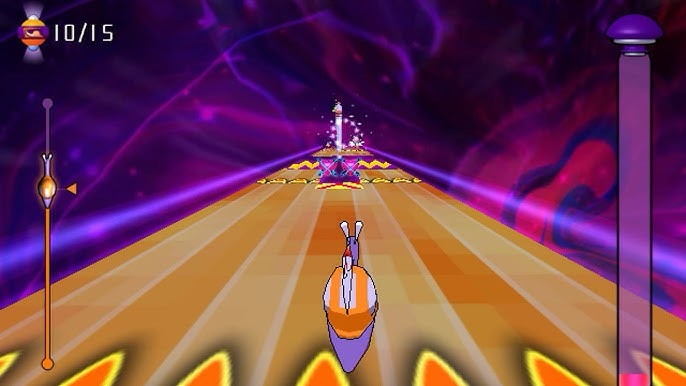
As you cruise down the lanes, you will face multiple obstacles – jumps over gaps in the space lane, slugs who will kill you if you bump into them, asteroids that you can blast out of the way with your weapon, and crystals that damage you if you hit them. There are also corkscrews, flips, turrets that shoot at you, and a few other dangers along the road. One of the greatest dangers, however, is speed – as the game goes on, you go faster and faster. You are also trying to collect as many packages as you can across the road (I cared less and less about this as I continued to play).
There are three modes – Postal (the main “campaign” with 50 levels to race through), Time Trial (allowing you to replay the levels from the campaign on a timer) and Challenge (letting you create a custom level by altering speed and difficulty). I mostly played through the Postal mode, though I dabbled in the others to see what they were.

The game is arcade-style – as you play levels, your score increases until you die (you start with 4 lives – when you lose all of them, you put a high score on the board and start again at the next level). You don’t have to go back to the beginning after each death (the game would be unplayable if you did – more on that later), you simply pick up where you left off. This type of game has gone out of style lately, and for something like Snail Mail, I can see why. If you are not actively competing with anyone, getting the highest score doesn’t necessarily feel like a necessary achievement.
My Replay Experience (Does It Hold Up?)
I’ll start off by saying that I had a lot of fun with Snail Mail. It has been many years since I played this game as much as I did this time, and as with many of these, I did not beat it when I was younger. Going through the whole game took me a few days of intermittent plays – I only got stuck on two or three levels throughout. Starting off, I have to say I was sorely disappointed. The first 31 levels were mind-numbingly easy, and when your game is only 50 levels, this is painful. It didn’t actually get challenging until level 32, which was my first death. Then, on level 33, I died enough times to lose my run (and since I had been playing for 31 levels I had a lot of extra lives). The difficulty spiked so much that I basically had to relearn the entire game from scratch. After six deaths in a row, I nailed this level, and was ready to move on. Level 41 then was the next trouble spot – it was frustratingly slow and introduced a new kind of corkscrew that required careful movement. This appears again in Level 45 which was one of the hardest levels in the game, forcing you to master the new corkscrew. It was very satisfying to beat, and was the first level since 24 to flip you upside down (a mechanic that went underutilized throughout the game).

The levels from 45 until the end were a lot of fun – fast paced challenges that forced you to make split second decisions and reactions in order to win. These levels were where this game shines. Unfortunately, you have to play 44 levels before getting here.
I am very satisfied to have played through the whole game – I ended up enjoying it more than I expected after the way-too-easy beginning. I have to remind myself that a game like this is marketed towards kids who have not spent hours grinding games that require split-second reaction time, and that levels I found frustratingly easy might have been appropriately frustrating to a new gamer. However, I do not believe that the concept holds up well enough to justify how slow the burn was – probably why I never ended up actually beating this game as a child.

So does it hold up? Yes and no. It was actually rather innovative for its time – one of the first fast-paced obstacle racers where you couldn’t slow down (unless you crashed). It was enjoyable to play. But it is missing some significant features that could be major improvements to the game. For instance – when you finish a level, it will show you how many packages you got out of the total. However, they only contribute to your score. The level has no marking showing you how many packages you got, or star rating, or anything for that matter. Because of this, I have no desire to try to complete a 100% run – why slog through the garbage without any in-game achievement? I’d much rather move onto another game rather than returning for more. Once the campaign is complete, there’s not much reason to play the game – its replayability is shallow, and one would only really replay the game if you wanted to get to those final levels again.
Accessibility
Unfortunately, this game is not available on modern hardware – you have to jump through a significant amount of hoops to make it playable. Is it worth it? Sure, if you want to play it badly. But there’s no reason to upend your system to play Snail Mail unless you have a significant number of other games to play. Some games from Shockwave and BigFishGames (another big brand with a similar style to Shockwave) have been ported to Steam, where they are kept updated for today’s systems, but unfortunately Sandlot Games was sold, and whoever owns the rights to Snail Mail has no interest in doing anything with the program, making it dangerously close to abandonware.
Apparently there is also a Wii port, surprisingly, but its controls were poor and it did not get good reviews. It also was released on iPhone, where it received positive reception until it was delisted from the App Store.
Final Thoughts
I feel like I’ve given Snail Mail a bad rap in this article, and maybe that’s because I’m reviewing with honesty, but in the end, I truly love this game. I know that I will eventually return to it when nostalgia calls, but even without nostalgia – if you have a system to make it work, it’s worth it to try it out. Shockwave allows you to download a 60 minute demo of all of their games, making it easy to try this one and see whether or not you enjoy it (if you choose to buy it, all your progress remains intact). It is also a great gateway game for kids – innocent and easy, fun but with challenges that force you to reinvent the way you were looking at the game. There’s a reason I enjoyed this so much when I was younger and I am sure other young gamers would have a similar experience.

All in all, would I recommend racing to get some old hardware to run Snail Mail and experience this esoteric piece of gaming history? Not really. But if you can, it’s worth checking out – it’s a game with plenty of charm and some solid gameplay despite its flaws. There is also a game called Chromadrome 2 apparently made by the same lead developer which I am planning to check out at some point! It seems to reinvent the Snail Mail formula into a new form, and has solid reviews!
Have you played any games similar to this own? Let me know in the comments below!

Related Reading
Deep Cuts: Insaniquarium
Taking a look at one of the favorite games of my childhood – Insaniquarium!

Deep Cuts: Tasty Planet
A dive into the 2006 game Tasty Planet, a wacky and fun eat-and-grow experience!

Deep Cuts: Pajama Sam – No Need to Hide When It’s Dark Outside
A review of Pajama Sam: No Need to Hide When It’s Dark Outside, an excellent point and click adventure game for young players!

 A Thinker in Space
Leave a reply to Deep Cuts: Tasty Planet – A Thinker in Space Cancel reply