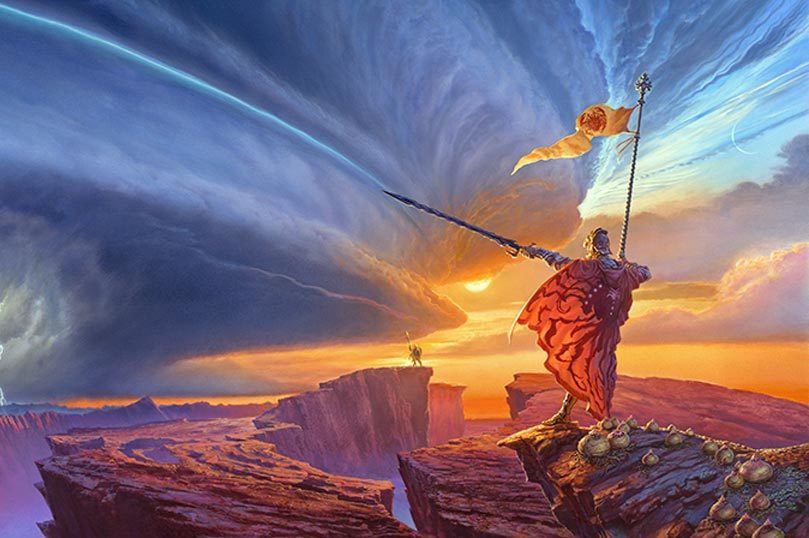
I have not done too many book reviews on this blog – I believe the only one I have actually done was a review on Death Troopers from many, many years ago. But I just finished The Way of Kings, and felt that adding my two cents would be worthwhile. For those unfamiliar, The Cosmere is Brandon Sanderson’s interconnected world, including the novel series Mistborn, The Stormlight Archive, and multiple standalone(ish) novels and short stories. Though I am still tackling my DC reading, I am also going to be reviewing the Cosmere novels as I go through them. These articles will likely be slower to arrive than the DC articles, as I read a bit slower lately (I could always surprise myself, though!). There are a ton of novels to get through, but The Stormlight Archive is the toughest due to the fact that each book is ~1000 pages long.

Despite its length, I cruised through The Way of Kings in just under 2 weeks. Going to the beach always gets me back into the groove of reading, and I had a great time working through this novel. Brandon Sanderson is an incredible storywriter and worldcrafter – he reminds me of why I write, and why I love crafting fiction. Every time I read his work, it makes me want to head to the keyboard and break open an old or new document and start creating. He is a modern master of fantasy, and gives me hope that success is still possible for a prolific writer.
Before I dive into the actual book, I do want to clarify that this article will contain fewer images than others I publish, mostly because I don’t want to look anything up (Sanderson is also a master of the plot twist, and I don’t want any of them spoiled for me in this 4 (soon to be 5) book series). Using the same method introduced in my article about A Short Hike, I will start with a spoiler-free review, and alert when I start talking about actual spoilers.
But let’s stop the meta talk and head into the meat of this hefty novel.
Spoiler-Free Review
I needed to start this review now before things become muddled – I have been reading Words of Radiance (book 2 in The Stormlight Archive) and I am sure that storylines will start to blend together. I wasn’t even sure if I was going to do a review on this novel when I finished, as it was published 14 years ago (which, honestly, is insane to me since my family just started reading Sanderson within the past 5ish years), and I know nothing about the content that follows (making the review sound relatively ignorant to those who are deep within the Cosmere). But in the end, I said “why not?”, and decided to put my thoughts on paper. Perhaps it will be even more fun to read what I have written here after I’ve caught up to Sanderson’s current publications!
Let’s start here. The Way of Kings is an excellent novel. Sanderson knows how to write a satisfying tale, and letting him loose on a seemingly unlimited canvas was a brilliant way to get some high quality fantasy out there. His worldbuildling in this series, as with the rest, is excellent. The characters feel real and nuanced, the storylines have satisfying arcs, and the story never drags despite its length. I can easily recommend this novel to anyone who loves long-form fantasy – even after nearly a thousand pages, I was still hungering for more.
The story can be picked up without any context of the Cosmere – you can definitely start reading Brandon Sanderson’s work here if this is more your speed than Mistborn. Both jumping-off points are equally effective (though Mistborn is certainly more accessible). I don’t want to say too much more, as this novel is worth going into without too much knowledge. It is a slow lore burn, and it is worthwhile to let Sanderson paint his canvas while you take it in from the man himself. So my spoiler-free review will end here at a simple recommendation – if you love epic fantasy, this is an essential addition to any collection (and I am sure the rest of the novels in this story will be as well).
The art of the novel is also spectacular, including full-page illustrations (the edition I have includes multiple full-color pieces as well). If you do not desire to read the spoiler-filled review, now is where I will leave you! If you read this novel, I hope you enjoy it as much as I did. Otherwise, read on!
Spoiler-Filled Review
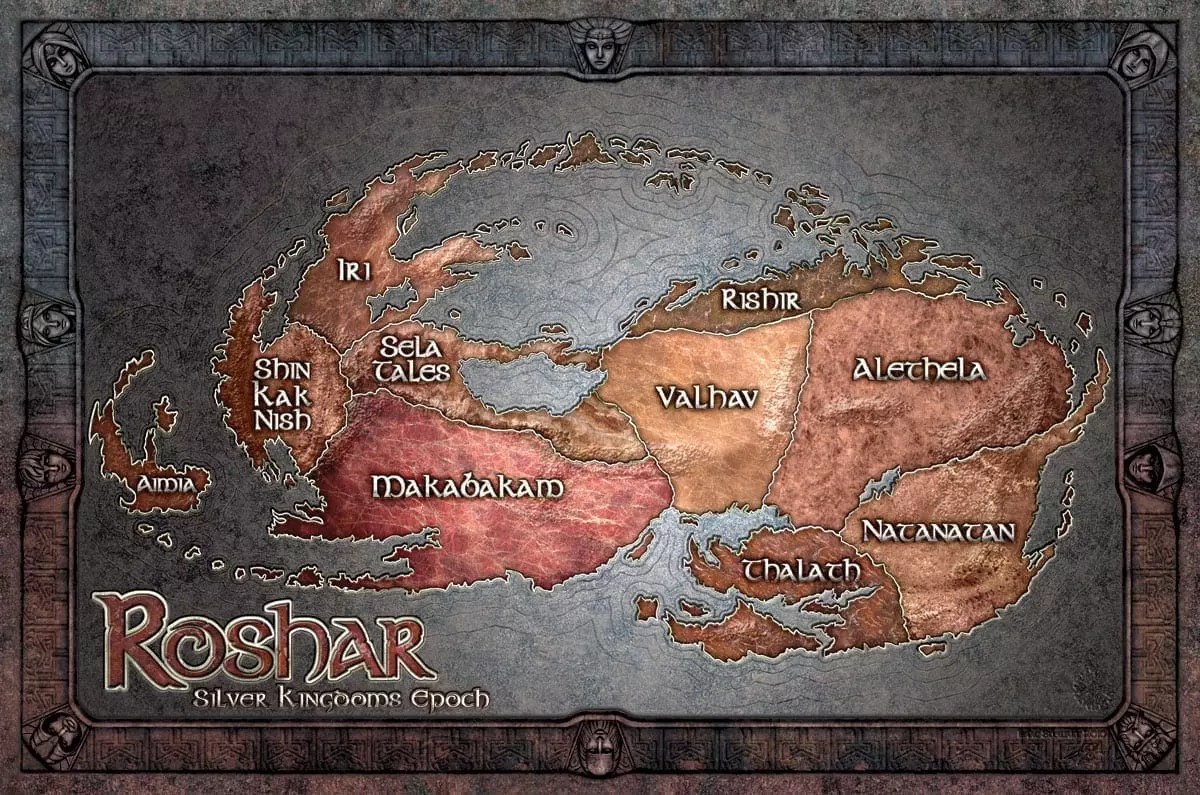
Okay, let’s get into the nitty gritty here. We have 4 plotlines to discuss, but before we get there, let’s talk about the worldbuilding. Sanderson is a modern king of worldbuilding – specifically in developing fascinating and unique magic systems in his stories. The Way of Kings, as I have already mentioned, is a slow-burn through the lore of The Stormlight Archive. And at the end of the novel, you still feel like there is an extensive amount of crucial information you are still missing about the world you have just spent so long within. Throughout this book, you know as much about the world the characters are living in as the characters themselves (at least the three main protagonists). Because of this, the slowly developing world system feels very natural to discover. Let’s start with the basics, such as they are. The world is called Roshar. It is a large continent with multiple islands attached, separated into multiple countries. Nearly the entire novel takes place in two locations – two of the main storylines take place in Alethkar (specifically in the Shattered Plains), and one takes place in the Phoenicia-style free-city of Kharbranth.
Through learning about these places and the characters within them, Sanderson introduces you to four different types of magic.
- Surgebinding – this is the first type of magic you are introduced to in the story through the eyes of a reluctant assassin who kills the king of Alethkar, setting the stage for the rest of the events of the book. Characters who can surgebind are capable of: A. changing the gravity of objects (and people) around them including themselves, altering which way is up and which way is down; B. making objects stick to one another with an incredibly strong bond; and C. giving an object gravitational pull so that other objects are attracted to it. A character that can surgebind takes in “stormlight”, a magical light that infuses gemstones in decoration and currency, and uses this magic to manipulate things around them.
- Soulcasting – a fascinating mechanic because of how easily it breaks a world without proper care (which Sanderson of course gives), soulcasters can transform matter from one form to another (create food out of sand, or metal out of wood, or smoke out of stone etc.). This is again done through gemstones.
- Shardblades/Shardplate – magical armor that is used in this world that bonds with the user and gives them powers. Shardplate makes them incredibly strong and can block most attacks unless they are focused or repetitive. Shardblade can cut through any and all substances with ease, though it turns to mist as it passes through human skin, killing whatever it touches. The shardblade in particular is fascinating as it turns into mist when not used and can be summoned by its possessor at will (though its arrival takes ten heartbeats).
- Spren – strange creatures of unknown origin that seem magical: one gains consciousness (named Syl) and apparently is the reason why Kaladin is able to Surgebind at the end of the novel (will get there momentarily).
These four systems are introduced and kept consistent throughout the course of the book, mixing together well. Even here, we don’t know the full story about any of these. What are spren? Where did the shardblades come from? Why can only two characters surgebind? How does Soulcasting work, and why can two characters do this without gemstones? There are so many mysteries that Sanderson leaves unsolved. In fact, the questions he does answer are few and far between, and some of them are answered by a notably unreliable source (never trust Sanderson until the whole story is finished).
The world of Roshar is full of conflict, and has been for all of living memory. War is a way of life, and currently Alethkar is at war with the Parshendi, a tribe of non-human creatures that are fighting for valuable gems on a battlefield again and again with the humans. Interestingly, the humans own parshmen slaves, who are the same species as the Parshendi, an independent nation of these creatures who have marbled red and black skin. The book tackles warfare well, exploring whether or not war is a necessary force, or if it is only used to destroy that which has value. Sanderson has yet to answer this question, as this story can be seen through either lens. In comes our three protagonists.
Before breaking down the four narratives interwoven through this novel, I want to mention Sanderson’s gatekeeping at the beginning of this book. If you pick up this novel without any context, and you start reading, the first few chapters are very difficult to get through. It takes 5 different chapters to finally establish a status quo. The first chapter is about the Heralds and seems crucially important to the series, though it is unclear what is actually happening here. The second is from the perspective of the assassin mentioned earlier. The third is a new character named Kaladin, and the fourth is the same character but months later after a significant event changes his life (so the rest of the characters are all new). The last one is the new perspective – Shallan. The sixth chapter is the first time we return to Kaladin and the status quo is now set for the rest of the first part of the novel.
This book is split into five parts, each with varying perspectives. There are three main characters – Kaladin, (who can be seen as the actual protagonist of the book, as his perspective is the one that is consistent throughout), Shallan, and Dalinar. These three stories are nearly entirely independent. At the end of the novel, Kaladin and Dalinar’s stories finally overlap, but Shallan’s is peripheral to the rest from beginning to end. That brings us to the second jarring thing about this book: lost perspectives. Each part contains two of the three perspectives, with Shallan and Dalinar alternating. Because of this, there will be long swaths of time where you simply don’t see Dalinar or Shallan, which, in a novel as long as this one, can be disappointing when you are enjoying their storylines. The third and perhaps most jarring part of this novel is the interludes – three chapters in between each part of the novel that are completely peripheral to the rest. Each interlude contains one chapter for Szeth, the assassin. The rest of the chapters are… strange? Each one has a different perspective, most of which feel completely disconnected from the rest of the narrative. The book ends and you still have no idea why you read some of them. Each one gives a tiny bit of worldbuilding that doesn’t feel relevant later? Occasionally, locations that show up in these interludes will be referenced in the story, but that’s about it. I am not sure yet what their purpose is, but I assume that the rest of these books follow the same model, so I look forward to discovering their purpose (and rereading them when necessary).

Another interesting thing about this novel is that I more than once felt the need to go back and reread a section, because the characters suddenly became relevant or the situation gets referenced again, this time in more detail. I liked this about the novel – it felt like you were uncovering secrets about things you had already seen but hadn’t understood in classic Sanderson style. As the story progressed and the three storylines moved forward, it was slow-paced without dragging, and let you really embrace the world Sanderson has created. I look forward to the rest of the novels, knowing that the pacing will likely change as we get closer to the climax in Book 5 (soon to be released).
The Four Narratives
Though I mentioned earlier that there were three main characters and three stories, there are actually four interwoven plotlines in this novel. The odd-one-out is Kaladin – he has two storylines dedicated to him, his present-day story and flashbacks to his childhood. These are both marked with Kaladin’s symbol (one of the cool little details in this novel is that each character has a symbol that is at the beginning of their chapters) but they are very different storylines.
Kaladin
I figured I would go through these stories in the order that they were introduced. Because of this, we start with Kaladin, the surgeon turned soldier turned slave turned bridgeman turned legend. Kaladin’s story in this novel is fascinating, mostly because it did not go where I expected at the beginning of the novel. You meet Kaladin as a soldier on the battlefield who is said to be “Stormblessed” – he is an incredibly good fighter and an excellent commander. When you meet him, you assume that he is going to be a soldier throughout the story, and that you will see him rise through the ranks. You would be incorrect. Something goes horribly wrong in this battle, and Kaladin ends up sold into slavery, where we see him next. The spirit he has shown has finally broken, and he is in a pit of misery, having tried to escape again and again and failed. He is assigned to be a slave in Bridge Four, joining the fight in the Shattered Plains where the war against the Parshendi is taking place. But instead of commanding a squadron, Kaladin is forced to run with a few dozen other men and carry a heavy bridge so that the soldiers can pass over massive caverns. Sanderson shows you the brutality of a bridge run at the very beginning so that you feel for Kaladin throughout his time here.
Now my assumption was that Kaladin would be in Bridge Four for a little while and then his story would truly take off. But again, I was incorrect. Instead, Kaladin’s plotline is focused on Bridge Four for the entirety of the novel, and we watch him break through his own depression and transform this miserable life into a life worth living, joining together the soldiers in Bridge Four until they are saved by Dalinar at the end and are set up for their role in Words of Radiance.
Kaladin’s story was one of the best parts of the novel. It moves very slowly – I was deep into the novel and saying “I can’t believe how little has happened in this book” despite thoroughly enjoying it – but it does so for a reason. Kaladin is a born leader, and you can see it in the way he analyzes his men and tries to figure out how to turn them from slaves into men, and then from men into soldiers. In a life as miserable as the life of a bridgeman, death is a mercy. Kaladin is able to figure out how to keep men alive, but what is the point if they don’t have anything to live for? The answer – companionship and friendship. Kaladin has these men build bonds with one another, and all of a sudden survival means something. They unite, and because of their bond they are able to save one of the most powerful men in the kingdom, and all of the bridgemen are saved from their terrible fates.
Kaladin’s story ties to an overarching theme about war that is pervasive through his and Dalinar’s storyline, as the surgeon in him is always struggling to come to the surface, and the “angel on his shoulder”, Syl, is acting as his conscience (though I am suspicious of Syl due to the fact that I am reading a Sanderson novel). In a story full of war and fighting, it is interesting that one of the main questions asked is “is this war worth it?”. The main characters understand war and the wanton violence it promotes, and they are beginning to question whether or not their fight is justified.
I am looking forward to seeing where Kaladin’s arc progresses, as his abilities as a Surgebinder come to the surface at the end of the novel leaving the reader hungry for more of his storyline. Bridge Four is in a good place at the end of this book, and it will be fascinating to see these characters grow and develop over the next few novels.
Shallan
Shallan’s story is intriguing in that it is the furthest away from the rest of the characters. Shallan is a girl about of about 19 years old who is desperately trying to save her house from destruction. Her father is dead (we never learn what happened here – I am sure we will get this backstory in one of the upcoming novels!), and she takes responsibility for his death. Her brothers are trying to maintain the house, but they have too many debts, as they learn that their father has been using a Soulcaster (a device used for soulcasting) to create profitable mining deposits quietly, and his Soulcaster is damaged and no longer usable.
Her goal? Earn the favor of Jasnah, princess of Alethkar, and become her ward. Then, steal her Soulcaster, swapping it with her own broken one, and run. During all of this, we learn that she is a tremendous artist with incredible skill, and we are introduced to a host of characters including the kindly king of Kharbranth and her young potential suitor, a religious man named Kabsal. Her story is intriguing – it takes place entirely within Kharbranth, and ties to Jasnah’s intense research of the Voidbringers. A couple classic Sanderson twists occur in this plotline at the end, including the revelation that the Voidbringers are actually the parshmen – a people enslaved throughout the world, and Kabsal (who is a very enjoyable character – all of his scenes were fun to read and he seems very genuine) tries to kill Jasnah and ends up dying to his own poison. We also learn that Jasnah can soulcast without a soulcaster, and that Shallan can do the same.
Shallan’s story is interesting because it feels so disconnected to the Shattered Plains. It was a lot of fun to read, and Jasnah’s character is layered and rich – I am looking forward to seeing more of her in Words of Radiance. Shallan wrestles through moral dilemmas throughout the book, and the most disappointing part is realizing that her interesting story is going to come to an end after she steals the soulcaster. However, Sanderson pulls the rug out from under us, and Shallan is still in her wardship at the end of the novel, and exciting turn of events to set up the future.
Kaladin (flashback)
I enjoyed the Kaladin flashbacks, though I was often wishing we would get back into the actual action of the book. These paid off pretty spectacularly – the scene where you learn why Kaladin is a slave is striking and excellently written. He was the son of a surgeon who never charged for his services, and has a sweet and kind younger brother you learn is going to die from the very beginning of the novel. The backstory built here helps us understand Kaladin on a far more personal level, as we see him attempt to synthesize how much he loves working with a weapon alongside how much he cares about the people around him. He grapples with healing vs. killing, and the dichotomy between doing no harm and harming to protect throughout the novel, and never quite reaches a conclusion except that in his situation, in order to save others he needed to kill those who would threaten them. I look forward to seeing his character continue to grapple with his nature vs. his nurture as the story continues.
Dalinar
Dalinar’s story takes us into the politics behind the war in the Shattered Plains – he is the brother of the murdered king, and is now dealing with King Elhokar, the son of the late King Gavilar. The Alethi are a people driven by war and battle, but Dalinar’s story is about him learning the cost of war, and beginning to doubt whether or not the Shattered Plains are worth contesting. War for the Alethi has become more about gathering wealth than about actually beating the enemy, the Parshendi (this war began because the Parshendi were about the make an alliance with Alethkar and then betrayed them by having Szeth assassinate the king). Dalinar’s ideas and ideals become stronger and stronger throughout the book, tying to visions that he has been having featuring The Almighty, a character referenced as “God” throughout the novel (though if you know anything about Sanderson lore, you know that there is likely something else going on here).
We learn that The Almighty is dead, and that Odium (whatever or whoever that is) is on the rise, a great villain who will wreak desolation over the world if he is not stopped. However, once again, these visions need to be called into question because this is a Sanderson novel. This plotline will likely continue into Words of Radiance, as we are not given a concrete answer to any of our questions. Dalinar is a good man, and he tries to bring others with him in his goodness throughout the book. However, these visions make him seem mad, and his obsession with a book of philosophy called The Way of Kings (appropriately) is concerning to his son Adolin (who takes a part in sharing some of the perspective in this storyline) and the rest of the kingdom. He is wrestling with whether or not to abdicate his throne throughout the book, and ends up deciding to take on a stronger leadership role instead, enforcing the Codes lined out in The Way of Kings for the entire military. Before he makes this decision, however, he is betrayed by his friend and left to die on the battlefield, saved by Kaladin’s bridge crew.
There’s a lot going on in this plotline – Dalinar’s story is engaging and is the place where we really learn what is happening in the kingdom of Alethkar, including learning the purpose of the bridgemen (to be killed so that the soldiers are protected from the volley of arrows that occurs when arriving at a contested spot). His plotline is one of the most interesting because of this, along with the visions that he is sent that build the lore of the world before current human record. The novel ends with us learning that the king of Kharbranth is actually the mastermind behind Szeth’s killings in the final part of the novel, and that Dalinar is his next target (setting up a Kaladin vs. Szeth fight that I am very much looking forward to!).
Final Thoughts
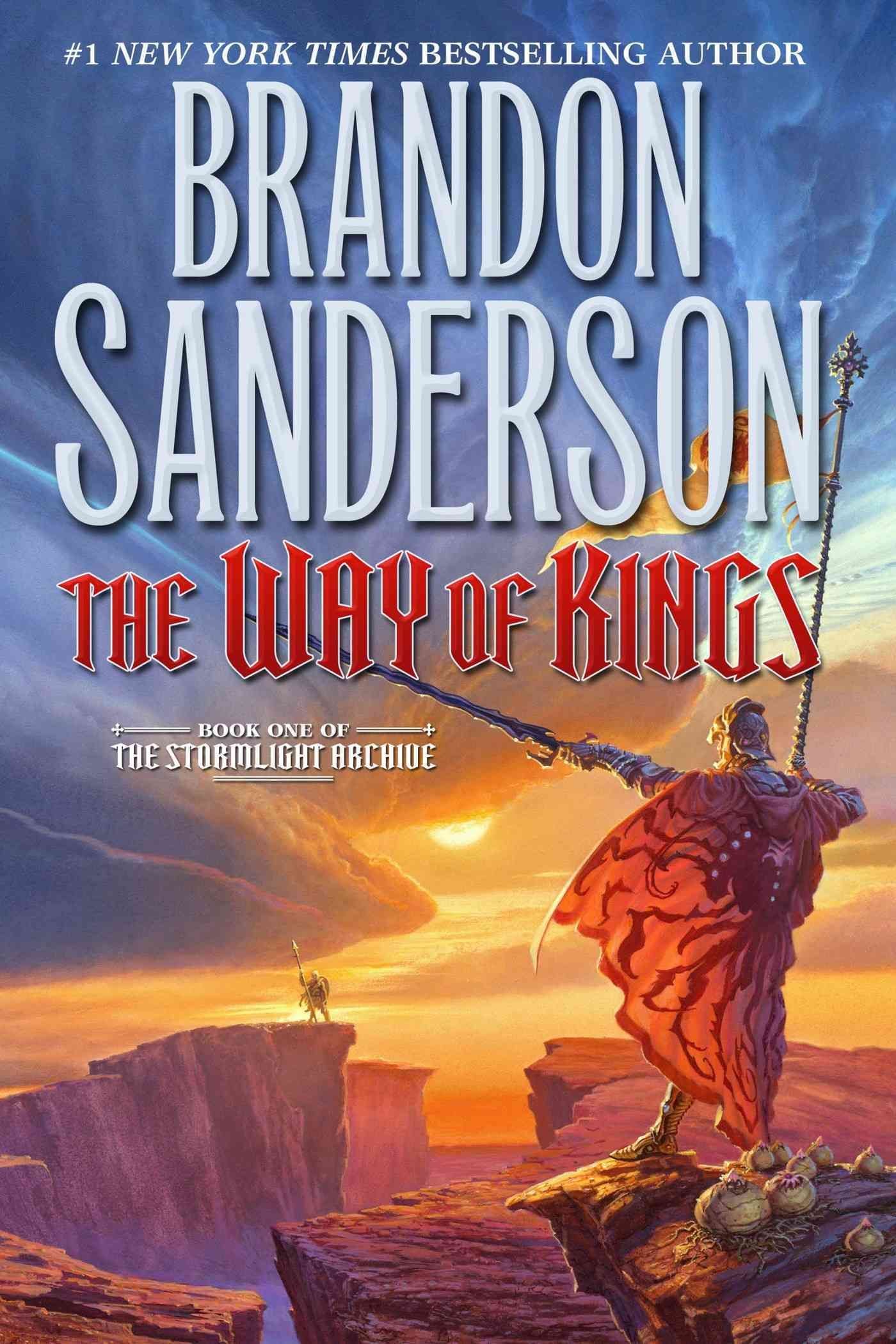
The Way of Kings was a compelling novel full of memorable characters and complex plotlines. There is so much to explore in The Stormlight Archive, and I am very excited to continue reading. When reading Mistborn, my feeling was that Sanderson was excellent at creating worlds and captivating plots, but a bit less so at creating characters with depth and nuance. This novel proves that I was incorrect – the characters and plot and worldbuilding are all top-notch. For all its quirks, this was an excellent read, and one I would recommend easily to anyone who loves this kind of fiction (as stated earlier). The strangest thing is how distant the events of this story will feel even at the end of the next novel, due to the length of each book and the series in general. I can’t wait to see what Sanderson has in store!
Related Reading

Alan Moore’s Swamp Thing (Part One)
The first part of a review of Alan Moore’s Swamp Thing – an incredible work of fiction that transformed the character forever.

Avatar: The Last Airbender – The Sequel and Tie-In Comics (Part One: #11-6)
In this two-part series, I explore the 11 tie-ins comics for the show Avatar: The Last Airbender, and rank them based on their overall quality.

Jon Klassen’s Hat Trilogy
A look into Jon Klassen’s Hat Trilogy – are these three books worthy additions to your collection? (Books for Readers Young and Old)


 A Thinker in Space
Leave a reply to The Stormlight Archive #2 – Words of Radiance – A Thinker in Space Cancel reply