
Two weeks ago, I covered Swamp Thing #20-36. Now, we’ll take a look at the rest of Moore’s run, some of the greatest comic stories ever written.
This is part of my DC Reading List – here are the references!
In his first issues of Swamp Thing, Moore reinvented the character completely. These were largely a reconstruction of the Swamp Thing mythos, and told multiple stories that were pretty independent from one another. This changes with issue #37, which begins American Gothic, a storyline that would span 13 issues leading up to its climax in #50. So without further ado, let’s get to the fourth arc in Moore’s legendary series.
Spoilers for Alan Moore’s Swamp Thing ahead
Arc Four – Prelude to Apocalypse (American Gothic: Part One) (#37-45)

The apocalypse is nigh, and it is heralded by none other than John Constantine, making his debut in issue #37. I love Constantine, and can’t wait to dive into Hellblazer (relatively soon, actually) to see where this character goes. Will it hold my attention in all of its staggering 300 issues? I am not sure. But I will certainly give it a fair attempt!
It is hard to believe that this is Constantine’s first appearance, because he is already incredibly well-developed from the moment he appears on the page. This Constantine is exactly the same character I know and love in media that has been written many years after his premier here.

There are some randomly terrifying sequences here that set up things developed much later (and continue a theme Moore sets up with seemingly disconnected horrifying incidents that are all intertwined).
This is also the first appearance of Swamp Thing regrowing his body from nothing, which will be developed rapidly throughout the next few issues.
We then get a rehash of the Vampire tale from Pasko’s run, which is fascinating and grotesque. It didn’t stand out to me as significant, though Swamp Thing wrestles with the genocide of the vampires at the end of the issues bringing up interesting moral quandaries about who deserves to live and who deserves to die.
#41 and #42 are fascinating stories about a plantation where events long past repeat themselves in modern day.

There is then an interlude including a fantastic one-off issue that I will discuss later and a strange issue involving a serial killer and a hint at Crisis on Infinite Earths.
#45 is Ghost Dance, which is a standout issue about guns and gun control. This was high up in my favorites – the social drama between the haunted house visitors was very well-executed for characters we had never seen before and never will again.
These stories face Swamp Thing with scattered evil all tied to a greater threat that is looming in the distance, as he is spurred forward by Constantine, who is doing… something in the background. All of this sets up the continuous story that begins in #46.
Arc Five – Apocalypse Now (American Gothic, Part Two) (#46-50)

The American Gothic storyline reaches its height in some of Moore’s best work in this series. This is my second favorite series of issues here, and brings his horrific elements to their highest level.
The Crisis on Infinite Earths crossover is smoothly executed, and Alan Moore using it to set up his new story was excellent. Parliament of Trees has ramifications that will last deeply throughout it the series, I assume far past Moore’s run.
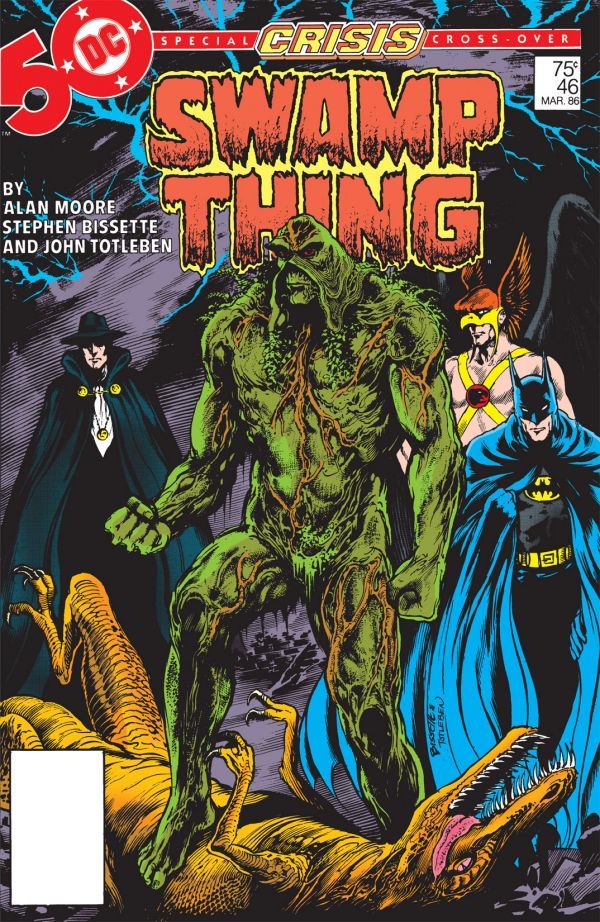
Then, the actual story picks up with some of the most disturbing content in Moore’s run, with the terrifying summoning ritual that occurs and the deep-dive into the afterlife that Moore set up in Annual #2. There are tons of familiar faces that show up in this storyline, and #50 features some minor but significant character deaths, including Zatarra, father of Zatanna.
The threat is set up well – a great darkness is being awoken that, for lack of a more concrete explanation, is going to kill God. However, in the end, there is instead a bonding of dark and light, good and evil mixing as they bond into a new substance. Moral grey personified. It works incredibly well – the darkness seeking answers was some of my favorite writing in the entire series.
Continuing his brilliance as a writer, Moore also sets up his next arc in the background, and then dives us into:
Arc Six – Beauty and the Beast (#51-53)
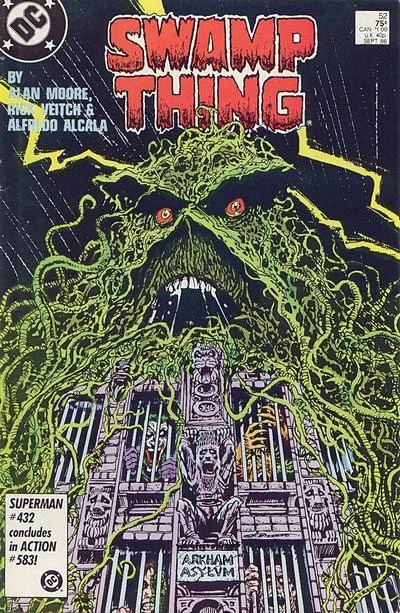
Despite only being 3 issues – this arc was my favorite in the run. It dealt with some hot-button social issues well, and showed the true extent of Swamp Thing’s power, both to create and destroy. The bulk of the action is set in Gotham, and so Commissioner Gordon and, of course, The Dark Knight himself play a significant rule in this conflict. Batman’s answer to the conflict works well in this world – if Abigail cannot be the wife of Swamp Thing, what about all other non-human creatures on Earth? Shouldn’t the law apply to them as well?
And since the government does not want to tangle with the likes of Superman, they pardon Abby and allow her to reunite with her love, when suddenly Sunderland returns in a big way, hiring Lex Luthor to help them kill Swamp Thing, and succeeds! Swamp Thing is gunned down where he stands and is killed on the spot before he can embrace his beloved.
Arc Seven – The Great Beyond (#56-64)

These issues were hit or miss for me. They completely transformed what to expect from Swamp Thing, as he has been hurtled into space, disconnected from Earth. This is less of an arc than a series of loosely connected issues that take Swamp Thing from world to world.
#56 – My Blue Heaven has Swamp Thing arrive on a planet where everything is blue, and he mourns his lost love by trying to replace everything he had lost. The picture of loneliness here is stark and well-done – this was one of my favorites from this series.
#57-58 brings Swamp Thing face-to-face with Adam Strange as he succeeds in helping the planet recover from a famine. This was a solid 8/10 issue for me – nothing crazy, but definitely enjoyable.
#59 and #60 were misses for me. #59 was a story about Abby’s father that could have been excellent, but ended up feeling jumbled and confused, something none of the other issues in this series have felt. #60 was an artistic masterpiece with great writing, but was very uncomfortable to read. I will likely not be returning to this issue.
#61 – All Flesh is Grass was a fantastic issue. I have a lot of experience with horrific elements in books and video games (though I shy away from horror films), so nothing in this series really disturbed me too greatly until this issue. This one got to me, and that set it apart from the others for me. It also sets up Swamp Thing’s return home, alongside some sciencey-wiency stuff that Swamp Thing learns.

#62 is all over the place, and at the beginning didn’t grab me. But the ending was incredible – the framing and art is very well done, and seeing Darkseid is always a selling point!
Then we get to #63 and #64, which wrap up the series nicely, including a cameo from Alan Moore himself (which I did not realize until looking it up later).
Single Issues
#43 – Windfall
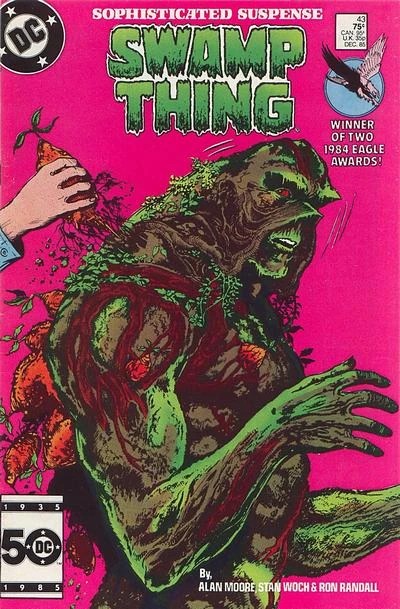
I cannot talk about this set of issues without talking about Windfall. This is easily top 5 issues of this comic for me, which is a testament to the quality of Alan Moore’s writing as Swamp Thing barely appears and the rest of the characters are original for this issue. This issue introduced Chester, who is a drug dealer in Louisiana. Despite his job, he is one of the best side characters in this series, showing up a few times after his introduction here.
This issue deals with the hallucinogenic effects of Swamp Thing’s yam-like fruits (though the reader understands that these are less of a drug than a gateway to connect with The Green), as Chester discovers one and ends up giving it to two desperate people, one whose wife is dying and wants something for the pain, one who is simply looking for his next fix.
What followed is a Mirror to Your True Self-style story – the tubers that Swamp Thing creates bring out what is truly in your heart. Because of this, they have a wildly different effect for both parties, creating a beautiful and masterfully written dichotomy.
#54 – The Flowers of Romance
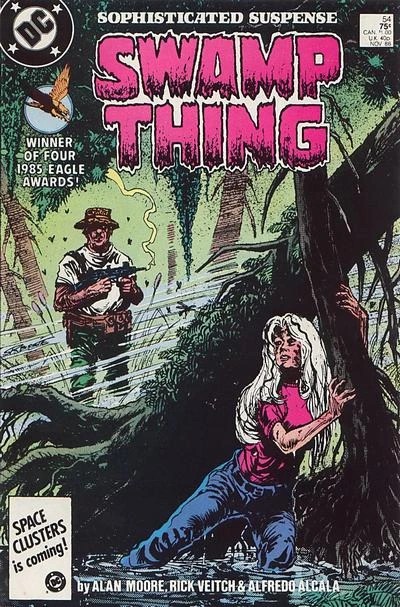
I can’t have read #1-19 and not talk about #54 – the fate of Liz Tremayne and Dennis Barclay. This is a very, very good issue. However, I felt it was a bit disrespectful to the character of Barclay to do what Moore did with him. Pasko’s version of Barclay was more or less a blank slate, and Moore’s transformation of him into a despicable human was nothing short of a character assassination. This issue was great, but I would have preferred it if it were not these two characters featured in this situation.
#55 – Earth to Earth
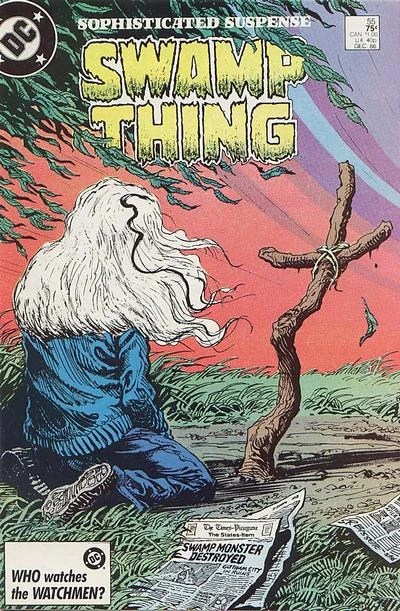
This issue was very, very good – the funeral of Swamp Thing was an excellent epilogue to the Gotham arc. Batman’s speech was well done, and the world acknowledging Swamp Thing for the first time as he truly was made for a touching sequence.
Final Thoughts
Alan Moore’s Swamp Thing was incredible (and the perfect length). At the end, it felt like Moore was ready to move on, and so the final issues do not leave us with longing for more content, instead satisfied with what we’ve received. It was dark, at times brutal, but always kept hope at the forefront. It is truly the end of a saga, one that I will look back on fondly and likely reread more than once. From here, the tone shifts dramatically as I head toward Green Arrow and Animal Man! I was worried that this series would spoil me for what is to come, but on the other side I am looking forward to more fun stories that are a bit less emotionally weighty (looking at you Justice League International). Stay tuned for more reviews in the future!!
Related Reading

Swamp Thing by Martin Pasko (#1-19)
In this article, I review The Saga of the Swamp Thing #1-19, the lesser-known run before Alan Moore’s.
Alan Moore’s Swamp Thing (Part One)
The first part of a review of Alan Moore’s Swamp Thing – an incredible work of fiction that transformed the character forever.

Superhero Fatigue – Fact or Myth?
A discussion on the concept of superhero fatigue, breaking down what it is, what causes it, and what can be done to fix it.

 A Thinker in Space
Leave a reply to Catching My Breath Through the Changes – A Thinker in Space Cancel reply