
This is now my fourth Cosmere review as I have been reading through The Stormlight Archive. If you would like to read the rest, I have them linked here.
The Way of Kings (Stormlight #1)
Words of Radiance (Stormlight #2)
Housekeeping
If you would like to get right to the review, jump down to Preface! But I figured I should include a bit of information about where I have been, and the lack of content published to this page lately.
Well, it is no secret (if you look at my article dates) that this article is not on time. As a matter of fact, it has been over a month since my last post. I could see the writing on the wall when I published my last housekeeping article, but didn’t realize how difficult even keeping to a weekly schedule would be. Unfortunately, my backlog of writing ran dry, and I have been so busy between caring for our baby, grading, teaching, doing lesson plans, doing some other personal writing, and generally feeling overwhelmed by this monster of an article that my blog has been on the backburner for me. I am hoping that I will be able to get myself back on track, but no promises yet! We’ll have to see what the future holds.
For now, thank you for being here and reading this article. It took a while to put together, and it has been a joy to continue (and finish) this review (even though I started it around a month ago, when I finished the novel). Let’s dive into the content!
Preface
Starting each of these articles is a daunting task. Reviewing one of these behemoths requires a multi-step process that seems insurmountable at first. First of all, I need to remember what happened in this book. My review of Edgedancer came out all the way back in August, so it has been two months since I started this novel, and this book is literally three smaller books stuffed into one massive manuscript.
The second issue with a Stormlight review is that so much happens in each novel. I know this sounds similar to the previous issue, but I don’t even remember what I knew about the world at the beginning of this book, much less what was happening when it began. The beginning feels like so long ago because of how many things occur within the pages of this novel. I believe one of my comments about The Way of Kings was that plots move very slowly. That is not the case with Oathbringer. This story is fast-paced and is constantly moving and weaving in unexpected ways.
Speaking of The Way of Kings, I then have to review my previous reviews, to remember how I broke down the events of each novel and to remember where I left off. Then, finally, I’m ready to begin breaking down the story from the beginning.

I am not including a spoiler-free review of this novel – consider this my spoiler-free section. Because I don’t think it’s possible to say much else without spoiling something. What I will say is that this is the best fantasy series I have ever read, bar none. Except perhaps The Lord of the Rings. Not only that, it is some of the best fiction I have ever read. Or watched. I have said this before, in previous articles, but every time I read one of these novels I am continuously impressed by how incredible Sanderson is as an author. Seeing how meticulously planned out a series of this scope is, seeds planted from the beginning only coming to fruition over 3,000 pages later, is mind-blowing.
Without further ado, because I am dancing too close to spoilers anyway, it’s time to dive in.
The Review
This book feels big. Not just in literal size, but in scope. The Way of Kings and Words of Radiance were marked by slow-paced action, especially in Way of Kings. Things happened gradually – Kaladin was in Bridge Four for the entire length of the first novel. Both were excellent, but took their time moving the plot along. Oathbringer has so much going on that it is hard to keep up. More than the other two novels, it feels like so much happens. Remembering the end of Words of Radiance was disorienting for me, because it feels so, so long ago that Urithiru was discovered, and that the Assassin in White was a notable antagonist. The lore expands so naturally in this book that it is hard to believe we didn’t know so many key facets in Words of Radiance, and that the Stormfather was not nearly as important of a character just one novel ago. Even the events at the beginning of this book feel like a distant memory, already getting a bit hazy.
There is so much to praise about Sanderson’s ability to craft fiction in these novels, but one of the biggest ones that shines in Oathbringer is that somehow, in a book with a startlingly large cast of characters, everyone felt important, and everyone was given something to do. We also had multiple characters given significant character moments throughout the novel that were natural and left the audience satisfied. Somehow, everything you want to happen in the novel happens, even if it doesn’t happen the way you expect.
The Worldbuilding
I suppose I need to start here, because so much lore is established throughout this novel that will need to be referenced constantly. After leaving us mostly in the dark in Way of Kings, and then expanding gently in Words of Radiance this book is what amounts to a lore dump. We learn:
- Who the Unmade are and how they function
- More about the three gods that exist within Roshar
- A ton about spren and their nature
- A ton about how the ideals work and what the Knights Radiant were able to do in the past
- Information about the three major spren that can be bonded to create bondsmiths
- A lot of information about Urithiru and the previous inhabitants
- The truth behind the Heralds
- The truth behind the Recreance
- How Shadesmar functions
- How the Fused work, and what they are
This lore is spread out throughout the book so that we learn it naturally, and it is key to understanding the events. Our main antagonist, Odium, has taken much more concrete shape in this novel, and he is quite a satisfying villain. There are also scenes or chapters that dump a significant amount of lore at the same time for the reader to process.
Dalinar
Dalinar is the “main” character of this novel, if such can be said. In the first one, this character was Kaladin. In the second, it was… Shallan? I think? That one wavered between Shallan and Kaladin. Part of what makes these stories excellent is that there is not a singular focus. All three of these mentioned characters have significant story arcs that are satisfying, and Sanderson spends a large amount of time developing each. Because of this, when looked on as a whole, each piece feels equally important to the events of the story.
Dalinar’s arc in this novel was satisfying and engrossing, as was Shallan’s in Words of Radiance and Kaladin’s in Way of Kings (which feels like so very long ago now that I’m so deep into this series). We finally get to see Dalinar’s story before the events of Way of Kings – Sanderson has been hinting at something that happened to cause Dalinar to visit the Nightwatcher and erase his memories. This reveal, as with most reveals in Sanderson literature, is quite satisfying. Dalinar’s presence in the forefront is a gem in this book – he was important in the other stories, but center stage was a comfortable position for him.
Dalinar’s relationship with the Stormfather is fascinating – it grows and develops throughout the story, and through it we gain a significant amount of understanding as to what is going on behind the scenes of this world.
We also see Dalinar struggle with his addictions – something I will address more thoroughly later on in this review.
Dalinar’s ascendance to some kind of meld of Honor and Man was an excellent way to end his arc, and his confrontation with Odium was amazingly well-crafted, bringing his storyline in this novel to a satisfying conclusion.
I don’t have much to say as far as other individual characters go – in this review, I will be addressing major plot threads instead.
Exploring Urithiru
Shallan’s arc in this novel is intricately tied to development of the lore Sanderson is trickling through the novel, and takes place over the course of three main events – the exploration of Urithiru, the mission to Kholinar, and the trip to Shadesmar. Over the course of each of these expeditions, Shallan’s personality, now separated into three, is a highlight as she seeks to balance her roles. The mystery of Urithiru feels like so long ago now – it’s hard to believe that it’s in this book, as so much happens after the conclusion of this arc. Shallan’s journey into Urithiru as Veil, working conjointly with Dalinar and the Ghostbloods to discover what is causing the “wrongness of the tower” is enjoyable to read, and the mystery of the double murders and the strange spren is catches our attention easily. Sanderson uses this as a vessel to showcase the Unmade, who end up playing a massive role throughout this novel.
Shallan’s confrontation with The Mother of Lies is tense, and her facing it reminded me starkly of the climax of the American Gothic arc from Alan Moore’s Swamp Thing, SPOILERS FOR ALAN MOORE’S SWAMP THING where Swamp Thing faced down an entity of great evil, and realized that it was not actually truly evil, and rather was something curious, trying to understand mankind. END OF SPOILERS This arc is an excellent primer for the events that take place in Kholinar as well.
Kaladin’s Journey
I loved seeing Kaladin visit Hearthstone, and going back to see his father once more. Sanderson uses Kaladin’s journey here to do a lot of character work on Kaladin himself, and to once again effectively worldbuild, showing us what to expect from the new Roshar after the coming of the Everstorm. Kaladin journeys with parshmen as they head towards a city where they are gathering, and we see these creatures humanized completely through Kaladin’s eyes. He befriends them, spends time with them, and has a very Kaladin reaction to them. He sees them as the underdog, downtrodden, and his Bridge Four instincts kick in – he seeks to protect them and to teach them. He sees, for the first time, that the enemy is not inhuman, just on a different side, something that proves to be undoing for Kaladin later on.
The Coalition of Monarchs
Dalinar’s thread is pretty consistent throughout the book, from beginning to end. Where other characters have multiple threads that they are following, Dalinar’s story revolves around his goal of creating a Coalition of Monarchs – joining together all of the political figures in Roshar in a communal area using the Oathgates so that they could strategize together to fight the Fused. Through this arc, we learn a ton of information about how the world works, including how the Heralds function. Watching Dalinar successfully wrangle the monarchs together was satisfying – I am a fan of political intrigue and hunger for it when it is less present in Sanderson’s world since he writes it so well (even though I have not talked about it here yet, this is a major highlight for me for the first novel of the Mistborn saga).
King Taravangian is here playing his game of 4D chess as Dalinar assembles the other rulers of Roshar, and though his plotting ends up unsuccessful, it is a thread that keeps you on edge throughout the whole novel.
Dalinar’s Backstory
This was excellently told – the mystery of what happened to Evi and even more significantly what happened when Dalinar contacted the Nightwatcher made these flashbacks even more enjoyable than Shallan’s and Kaladin’s in the previous two books. I always looked forward to the next chapter of this story, and it never felt like it was taking me out of the action since Dalinar’s arc was so intricately tied to the flashbacks here.
Evi’s death was about what I expected – I assumed he was responsible for her death in one way or another, but the sequence was still unexpectedly brutal. The Thrill takes center stage here, and some significant portions of Way of Kings are explained. Seeing Cultivation for the first time was incredibly interesting – she has been nestled in the back of these stories so far and her role in the overarching story is yet to be revealed, but her interaction with Dalinar was ethereal and meaningful, and Dalinar’s recovery from his suffering and his ability to finally find forgiveness due to remembering his experiences was excellent and made him a far more nuanced character, setting him up for Dalinar’s big moment in this story.
Kholinar
This is a huge part of the novel, and is one of my favorite arcs so far in The Stormlight Archive as a whole. Wit makes a return for this segment, and Shallan, Adolin, Kaldin and Elhokar (who really shaped up into such a good character in this novel) are all given satisfying character moments and things to do. The team is here for a long time, trying to figure out what is going on in the heart of Kholinar, eventually learning that there are two Unmade in control. The city, for all intents and purposes, is besieged by the Fused, and Kaladin joins the border patrol, which gives him new characters that he can get to know. Once again, he finds a niche into which he fits in well – he continues to be a man that easily finds people he connects with and loves like family (which leads to his big moment in this novel).
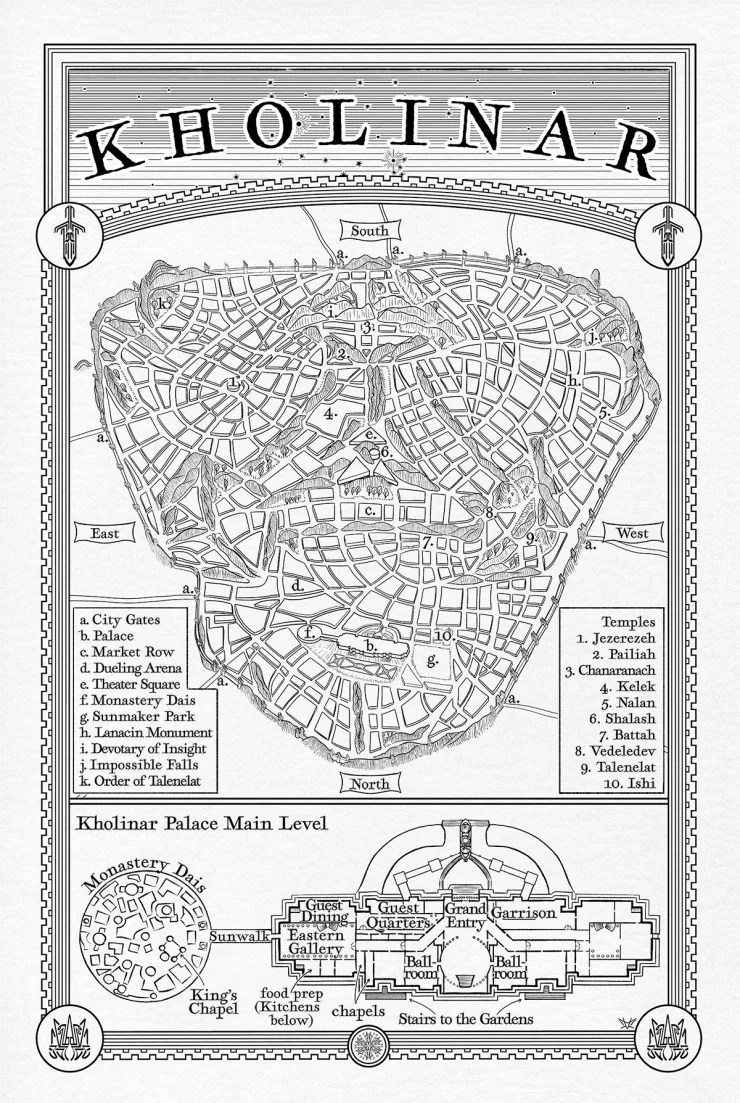
Shallan’s espionage is intriguing and Sanderson gives us plenty of interesting mysteries to keep us guessing throughout this section. Throughout this arc, she continues to act as Veil, and takes on the noble goal of giving food to the needy. It sounds like she is doing the right thing, but as she says later: though Veil pretends to have street smarts, she doesn’t really. Shallan’s attempts to do good things turn into one of the most brutal scenes in the entire series, teaching her an important lesson – pretending is not the same as knowing. Sanderson gives us a difficult reminder of how charity needs to be done with carefully and with a full understanding of the situation, or it can result in creating even worse circumstances than were there in the first place.
Shallan has her big moment in Kholinar after this, meeting with Wit and finally allowing herself to be pieced back together in some form, which sets the course for her storyline for the rest of the novel. Adolin continues to be fully supportive of Shallan, finally settling into a healthy relationship with her as she reveals Veil to him (and her subordinates). Veil still has a thing for Kaladin, though, which is a bit frustrating.
This all leads to a climax that could have been the end of an entire novel because of how good it was, but as it is, is only the end of the second third of this behemoth. Our four main characters finally invade the palace to take it back! Elhokar confronts his wife, and learns that she has bonded an Unmade by choice (sounds like this was something Gavilar was investigating, interestingly). Elhokar is so bent on saving his wife and his son, but in the chapter “The One You Can Save” he decides to leave his wife behind and save his son. The charge out of the palace leads them to a confrontation with the Parshmen, now called Singers, which is one of the best scenes in Stormlight so far. Kaladin sees his friends fighting his friends, killing one another, as the Parshmen he befriended earlier fight against the wall patrol he had become a part of, and Kaladin freezes. He cannot bear to watch people he loves killing one another, and then, during all of this chaos, Moash shows up out of nowhere and kills Elhokar! Right as Elhokar is saying the first ideal to bond a spren and become a Radiant.
It was an incredible scene that leaves you gasping for breath, devastated. In that moment, you feel what Kaladin feels. Kaladin, Adolin, Shallan, and the captain of the wall guard, Azure, narrowly escape the palace, and head towards the Oathgate, which Shallan activates despite a warning by one of the Unmade not to use it, and all of them are teleported into Shadesmar for the next main arc in this story.
Shadesmar

Surprise! This is where we’re headed next. Shadesmar is fascinating – Sanderson does a massive lore dump and shows us where spren come from, what they look like (truly) and what this world actually is. Turns out there are people living in Shadesmar, and there is a whole economic system to explore in this world. This journey is remarkable, with plenty of interesting events and situations brought up – it seems the Fused can travel to Shadesmar much easier than mankind through the “perpendicularity” in the Peaks (where I am guessing we will be headed in either the next novel or in book 5).
The exploration of the sentient spren on this side of reality is fascinating – the three realms have become much more relevant here (physical, cognitive, and spiritual), and seeing them in action is wild. Sanderson creates a completely new adventure for us here, one that feels fresh but still engaging. This was certainly a highlight of this novel!

The Skybreakers
I almost forgot to include this because of how detached from the rest of the novel it is. We get a ton of information about how the Radiants work through seeing the Skybreakers, who we get to experience through Szeth’s perspective (which is amazing – I love Szeth’s redemptive arc and I am thoroughly looking forward to his role in future events). It is a bit jarring whenever we transfer to Szeth’s story, but him and his strange, talking sword who is a spren but isn’t? And is also being hunted by Azure for some reason maybe? makes for a fascinating mini-arc that I look forward to see developed more closely in Rhythm of War (if that is where we will see this continue).
Interludes
These interludes were much more cohesive than previous pieces, as each one feels connected to this story itself. Some highlights:
Venli’s Arc: Venli has a few great scenes here, resulting in her bonding an honorspren and becoming a Knight Radiant?? I did not see that coming, and it was a fantastic twist.
Taravangian: There is a great shot of Taravangian at full-force. Seeing his intelligence twist him into something evil is fascinating and an excellent commentary on intelligence without heart.
Mem: A woman who works as a laundrywoman for Mraize is the main character of this one, which was an extremely unique point of view, and allows us to see another Herald!
Teft: Teft’s arc dealing with addiction is highlighted in this novel as a minor plot point, and his interlude is a chilling development in his story.
Rysn: We see Rysn again for the first time since her appearance in Words of Radiance, and her little story here is very interesting. I thoroughly enjoyed her small arc in this novel, and hope we see more of her in future stories.
The Climax – Revelations and the Battle of Thaylena
First, the revelations. Two we knew about, that are only revelations for other characters, and one huge lore drop: human beings are invaders to Roshar. They are not the original inhabitants, the Singers are. Not only that, but Odium (who, by the way, feels like a huge threat throughout this book and is a very well-developed antagonist) was brought to Roshar by the humans. This shakes the Radiants and the Coalition to their core, and is not fully resolved in this novel.
The Battle of Thaylena is a horrifying scene, one where you are not sure quite who will be victorious. Odium turns Amaram and his army against Thaylena, which is a huge problem for international relations and the war, and during the battle Dalinar goes toe to toe with Odium. Odium has been preparing a champion (a being with nine shadows) throughout the novel, and we see glimpses of this from the beginning of the story. I was convinced this would be Renarin even before Sanderson gives us a Red Herring in showing us that Renarin has bonded a voidspren (no idea where that story point is going to go), giving us a captivating scene where Jasnah almost kills him.
In the climax, it is revealed that Odium’s champion would actually be Dalinar (which made me verbally go “oh… oh noo”. An evil Dalinar would be terrifying. He overwhelms Dalinar with The Thrill, a product of the Unmade that has joined them on the battlefield, and reminds him “who he is”. Dalinar is mere moments away from falling, and Odium enables this in a warped perversion of Christlike redemption – he asks Dalinar to “give him his pain”. He tells Dalinar that he is not responsible for all of his choices – Dalinar was controlled by The Thrill, by Odium. He gives Dalinar an out – telling him that he does not have to take responsibility for his guilt. It is a chilling and excellent scene, and because of how much Dalinar has been withdrawing throughout the book, the reader is unsure as to what will happen. Dalinar, however, owns his pain, refusing to give in, and in doing so, binds himself with the spiritual realm? We are not sure yet what happened, but he seems to have taken a piece of Honor within him, as he is now able to open a perpendicularity AND restore Stormlight. Odium flees, and Dalinar captures The Unmade in a gemstone designed for that purpose.
Alongside all of this, Szeth makes his decision to join Dalinar and the Knights Radiant, which was an amazing character moment and was a bit jaw-dropping for me. Alongside him, Lift plays a huge role (she has grown on me quite a bit throughout this novel).
The story ends with Jasnah taking over as Queen of Kholinar, which is a fun twist and something that I am thoroughly looking forward to seeing developed, and Adolin and Shallan finally getting married (I love them as a couple and this was one of my favorite parts of the novel!! It was so satisfying to see their romance pay off and HOPEFULLY see the end of the weird love triangle that has been dancing in the background).
All in all, it was a wholly satisfying conclusion once again.
The Struggles of the Mind
One unexpected theme that became very poignant in this novel is mental illness. It is becoming clear that many of these characters struggle from diagnosable illnesses – Kaladin struggles from depression (has since the beginning), Shallan is struggling with a form of mental detachment which is manifesting itself in multiple personality disorder, Dalinar struggles with alcoholism driven by guilt, and Teft is an addict (though he plays a much more minor role). Each one of these characters has ups and downs, and they have struggled with these in previous books as well. This takes center stage in this novel, however, as Kaladin enters a depressive episode in Shadesmar that is very realistic – Sanderson understands how depression works and has represented it very well with Kaladin throughout his arc. Shallan’s personalities are getting out of control in this book, and she has to learn how to bring them under control – to be Shallan, and to have her personalities an extension of her rather than controlling her. She is still learning though, and has not yet succeeded in fully pulling herself together.
Dalinar, though, takes center stage. This book has a blunt look on alcoholism, its causes, and its ties to depression and self-loathing, and Dalinar’s relapse as he gets back his memories is painful but completely in-line with a realistic depiction of his illness. However, he is able to conquer this, and though his road will still be challenging, his acceptance of his guilt and forgiving himself is a huge part of his story and is the reason he can stand up to Odium at the end of the novel.
These illnesses are presented realistically, showing us that our heroes are flawed and struggle with their own minds, even as they fight epic battles around them. It reminds us that heroes in a world of suffering and pain likely have trauma, and that has consequences. This story isn’t just about heroes fighting evil, it is about heroes conquering very real, very dangerous inner demons. Sometimes victorious, and sometimes losing again and again. I did not expect this in an epic fantasy, but it fits wholly with the world Sanderson has created for us.
Final Thoughts
This article took me a ton of time to write, as I said at the beginning. I started writing it, got about a quarter in, and then became so overwhelmed that I stopped working on my blog for a month. Oathbringer was such a beast and had so much going within it that I couldn’t even remember where it began. I basically wrote about how difficult the article was going to be to write, and then stopped.
Since then, I have fully read Dawnshard (so I hopefully will be writing that review soon!) and am pretty deep into Rhythm of War, so it was a bit challenging to come back and review this book. But now that I am up to date, I am hoping that I will be ready to write the rest without too many issues, including a review of Wind and Truth when it drops in December!!
It is not an exaggeration to say that this is perhaps the best series of novels I have ever read in my entire life, and I am hoping that it will continue to keep this quality through the rest of the novels. Thank you, Sanderson, for taking so much time creating a world that feels real. Your novels are an inspiration, and every time I read one I am reminded of all of the stories I want to craft. I can’t wait to keep reading!


 A Thinker in Space
What do you think?